Home > Centrelink > Youth Allowance for Job Seekers Guide
Youth Allowance for Job Seekers Guide: Eligibility & Application in 2026
Transitioning from school or training into the full-time workforce is a significant milestone, but finding the right job doesn’t always happen overnight. During this critical period, having a secure financial safety net is essential so you can focus on building your resume, attending interviews, and securing long-term employment.
For young Australians aged 16 to 21, the primary form of government income support while looking for work is Youth Allowance for Job Seekers. While similar to the payment offered to full-time students, the Job Seeker stream comes with a unique set of rules, responsibilities, and “mutual obligation requirements” that must be strictly followed to keep your payments active.
Navigating the Centrelink system can be daunting. From understanding whether you are classified as dependent or independent, to signing your first Job Plan with Workforce Australia, the process requires careful attention to detail. Missing an appointment or failing to report your income can result in immediate payment suspensions.
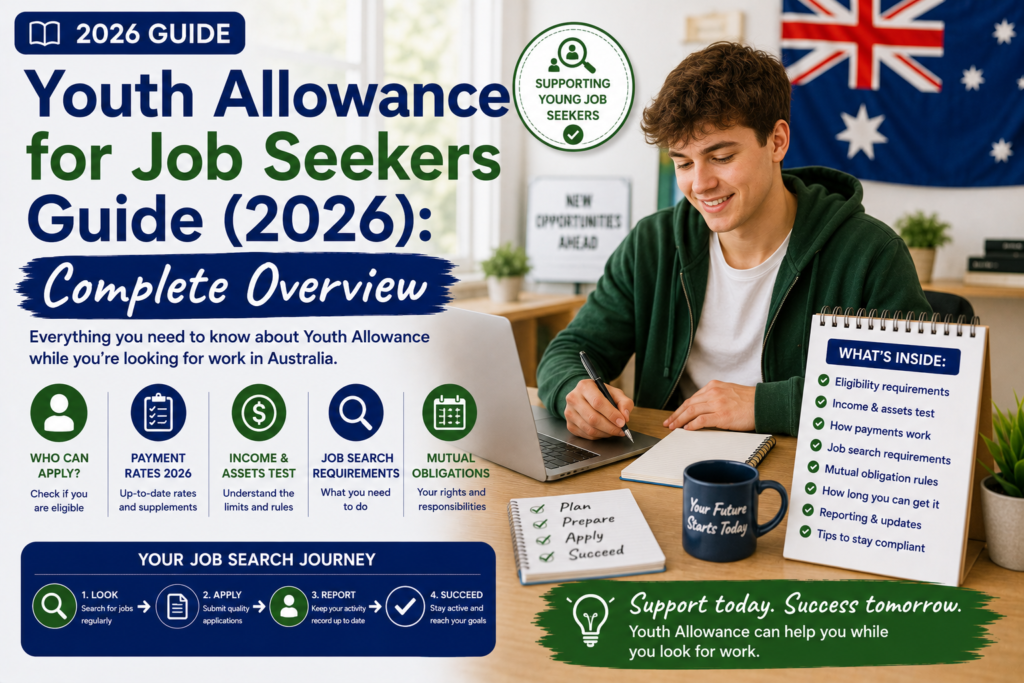
In this comprehensive Youth Allowance for Job Seekers Guide, we will walk you through exactly who is eligible, how the payment structure works, the step-by-step application process, and what you need to do to meet your mutual obligations. Whether you have just left school or are transitioning between jobs, this guide will provide the clarity you need to secure your financial support.
Key Takeaways
- Age Limits: This specific payment is strictly for young people aged 16 to 21. Once you turn 22, you will automatically transition to the standard JobSeeker Payment.
- Mutual Obligations: You cannot simply collect the payment; you must actively look for work, apply for a set number of jobs each month, and attend meetings with an employment services provider.
- Dependency Status: If you are under 22 and not deemed ‘independent’, your parents’ income will heavily influence how much you receive.
- Reporting is Mandatory: You must report to Centrelink every 14 days, declaring any income you have earned, even if it is $0. Failure to report means you do not get paid.
- Digital First: The most efficient way to apply and manage your mutual obligations is by linking Centrelink to your myGov account.
Who is Eligible?
Before beginning a lengthy application, it is crucial to ensure you meet the strict eligibility criteria. Applying for the wrong payment type is a common mistake that leads to unnecessary delays. To quickly verify your standing, we recommend using our JobSeeker Eligibility Checker or the Youth Allowance Checker.
To qualify for Youth Allowance as a job seeker, you generally must satisfy all of the following conditions:
- Age: You must be aged 16 to 21. If you are 22 or older, you must apply for the JobSeeker Payment instead. (Note: Full-time students can stay on Youth Allowance until they turn 25, but job seekers transition at 22).
- Work Status: You must be actively looking for full-time work. You can be working part-time or casually, but your income must be under the cut-off limits.
- Residency: You must be an Australian resident and physically live in Australia. If you are a new migrant, there may be a waiting period.
- Income and Assets Test: You must pass the personal income test (how much you earn from a part-time job) and the personal assets test (how much money you have in the bank or the value of a car you own).
The Importance of Independence
One of the biggest hurdles for young job seekers is the Parental Income Test. If you are under 22, Centrelink automatically assumes you are “dependent” on your parents. This means your parents’ income and assets will be assessed, and if they earn above a certain threshold, your payment will be reduced or denied entirely.
You can bypass this if you can prove you are “independent.” You may be considered independent if you:
- Have supported yourself through full-time employment for a specific period (e.g., working 30 hours a week for at least 18 months in a two-year period).
- Are married or in a registered relationship.
- Have a dependent child.
- Cannot live at home due to extreme family breakdown or risk to your physical/mental health.
If you are dependent, ensure your parents are ready to provide their tax details. You can read our deep dive on this process in our Application Support Guide.
How It Works: Mutual Obligation Requirements
Unlike some other government benefits, Youth Allowance for Job Seekers is not a passive payment. It is a conditional payment. In exchange for financial support, you must agree to, and fulfill, Mutual Obligation Requirements.
These requirements are managed through Workforce Australia (or specialized providers like Disability Employment Services or Transition to Work, depending on your circumstances). Here is how it works:
- The Job Plan: Upon approval of your claim, you will be required to negotiate and sign a “Job Plan” (sometimes called an Employment Pathway Plan). This is a legally binding agreement outlining the activities you must undertake to keep receiving your payment.
- Job Searches: The most common requirement is applying for a specific number of jobs each month. For most job seekers, this is around 20 jobs per month, though this can be reduced depending on your local job market or personal capacity. You must log these applications in your Workforce Australia online portal.
- Attending Appointments: You will be assigned to an employment services provider or placed in the Workforce Australia online system. You must attend all scheduled phone, video, or face-to-face appointments.
- Activities: After a certain period on the payment, you may be required to participate in additional activities, such as Employability Skills Training, voluntary work, or Work for the Dole, to build your skills and resume.
The Demerit Point System
If you fail to meet your mutual obligations—for instance, if you miss an interview with your provider without a valid excuse, or fail to apply for your target number of jobs—you will incur demerit points. Accumulating too many points can lead to your payment being temporarily suspended, or ultimately cancelled entirely. It is critical to stay on top of your obligations through your myGov account.
Benefits: How Much Will You Get?
The amount of Youth Allowance you receive is not a flat rate. It fluctuates heavily based on your living situation, whether you have children, your dependency status, and how much you earn from part-time work.
As of recent indexation, the base rates generally fall into these categories (note that these are approximate examples and change regularly):
- Single, no children, under 18, living at home: Lowest base rate.
- Single, no children, 18 or older, living at home: Slightly higher base rate.
- Single, no children, living away from home (Independent): Highest standard base rate, designed to help cover rent and utilities.
- Single, with children: Higher rate to assist with dependents.
Additional Supplements
Depending on your situation, you may also qualify for extra financial boosts on top of your base Youth Allowance:
- Rent Assistance: If you rent in the private market (not public housing) and pay above a certain threshold in rent, Centrelink will provide extra money to help cover your housing costs.
- Energy Supplement: A small, automatic fortnightly payment to help with household energy bills.
- Pharmaceutical Allowance: Automatically included to help cover the cost of prescription medicines if you are eligible.
If you start working part-time, you do not immediately lose your Youth Allowance. Thanks to the Income Bank and taper rates, you can earn up to a certain amount before your payment starts to reduce. Once you earn past the cut-off limit in a fortnight, your payment for that fortnight will be zero. Use our Benefits Calculator to model how working will impact your payments.
Step-by-Step Process: How to Apply
Applying for Youth Allowance as a Job Seeker requires methodical preparation. Follow these steps to ensure your claim moves through the system smoothly:
- Set Up Your Digital Identity: The application process is entirely digital. You must create a myGov account. If you have never received Centrelink before, you will need to prove your identity to get a Customer Reference Number (CRN). You can do this online using the myGovID app or by visiting a service centre. See our Guide to Linking Centrelink for help.
- Gather Your Evidence: Collect your Tax File Number, bank account details, proof of identity, and any separation certificates from recent employers. If you are dependent, tell your parents they will need to provide their income details.
- Start the Claim: Log into myGov, navigate to Centrelink, click “Make a Claim,” and select “Looking for Work.” Follow the prompts. The system is adaptive and will ask questions based on your previous answers.
- Submit Supporting Documents: At the end of the claim wizard, you will be given a checklist of required documents. Upload clear photos or PDFs directly to the portal. Do not submit the claim until every required document is attached.
- Book an Appointment: After submitting, you may be prompted to book an initial phone appointment with Centrelink to verify your details and discuss your job search intentions.
- Wait for Assessment: While waiting, you may need to register with Workforce Australia and complete a Job Seeker Snapshot questionnaire to determine what level of employment support you need.
Documents Required
A complete claim is processed significantly faster than an incomplete one. Have these documents ready before you begin:
- Identity Documents: e.g., Australian Passport, Birth Certificate, Driver Licence, Medicare Card. (Check our Medicare Card Checklist if yours is lost).
- Tax File Number (TFN): Mandatory. If you don’t have one, you must apply via the ATO.
- Bank Details: The BSB and account number where you want to be paid.
- Employment Separation Certificate: If you recently quit or were fired from a job, Centrelink requires this certificate from your ex-employer to verify why you left and if you received any final payouts (like accrued annual leave).
- Parental Income Details: If you are dependent, your parents will need to complete the Parental Income Test Assessment (Mod PT), or provide their TFNs for automatic ATO data matching.
- Medical Certificates (If applicable): If you have an injury or illness that prevents you from working full-time immediately, providing a Centrelink Medical Certificate can temporarily exempt you from mutual obligations.
Processing Times
When you are out of work, waiting for financial support is stressful. The processing time for Youth Allowance for Job Seekers is generally faster than the student stream because there is no need to wait for university enrolment verifications.
On average, if you submit a perfectly complete claim with all documents attached, you can expect an outcome within 14 to 28 days (2 to 4 weeks).
However, if Centrelink has to write to you asking for a missing Employment Separation Certificate, or if your parents delay providing their tax details, the claim will be placed “On Hold,” and processing can stretch to 6 weeks or more. If you are in severe financial distress and have less than a few hundred dollars to your name, you can call Centrelink and request that your claim be processed under Severe Financial Hardship provisions.
Common Mistakes and Delays
Avoid these frequent errors that cause job seeker claims to be rejected or delayed:
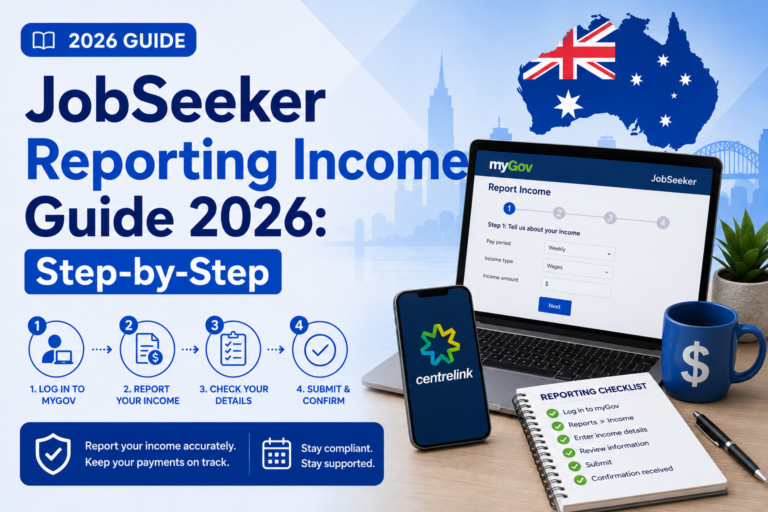
- Failing to Report Income: Once approved, you must report your income every 14 days on your designated reporting date. If you forget to report, your payment will not be issued. If you earned $0, you must still log in and formally report $0.
- Missing the First Provider Appointment: After approval, you will be assigned an employment provider. If you skip your very first introductory meeting, your payments will be suspended immediately.
- Incorrect Dependency Status: Trying to claim independent status without providing solid proof (like extensive PAYG summaries proving your work history) will result in long delays while manual assessors review your file.
- Ignoring the myGov Inbox: Centrelink does not call you if a document is missing; they send a letter to your myGov inbox. Ensure your myGov notifications are set to alert your phone via SMS.
Tips for a Successful Application
- Claim Immediately After Finishing Work/Study: Do not wait until you have exhausted your savings. Claim as soon as you are unemployed. Centrelink backpays to the date you submitted the complete claim (subject to waiting periods), but they will not backpay for the weeks you delayed applying.
- Use the Express Plus App: The Express Plus Centrelink App is the easiest way to report your fortnightly income, upload documents, and check your next payment date.
- Understand Waiting Periods: Be aware that you might not get paid immediately upon approval. If you have substantial savings in the bank, you may serve a ‘Liquid Assets Waiting Period’. If you received a large payout from your last job, you will serve an ‘Income Maintenance Period’.
Frequently Asked Questions
What happens when I turn 22 while on Youth Allowance?
When you turn 22, you age out of Youth Allowance for Job Seekers. Centrelink will automatically transition your payments to the standard JobSeeker Payment. You do not need to submit a completely new claim, but you will receive letters explaining the new payment rates and any changes to your obligations.
Can I study part-time while on Youth Allowance for Job Seekers?
Yes, you can undertake part-time study or short training courses, provided they do not interfere with your primary mutual obligation: actively seeking and being available for full-time work. Your employment provider must approve the study to count towards your activity requirements.
Do I have to accept any job offered to me?
You are required to accept any offer of “suitable paid work.” If you refuse a job offer without a valid, acceptable reason (such as severe health and safety risks at the workplace), your payment may be cancelled, and you could face a penalty period where you cannot reapply.
What if I get a job but it’s only 10 hours a week?
You must report your income and hours worked every fortnight. Your Youth Allowance will likely be reduced slightly based on your earnings, but you will still receive a partial payment. You will also still be required to look for more work to make up the difference until you find full-time employment.
Official Resources
For the most current rates, legal obligations, and portal access, always refer directly to the official government portals:
Conclusion
Youth Allowance for Job Seekers is a vital support system designed to help young Australians aged 16 to 21 navigate the challenging gap between education and stable employment. While the application process and the ongoing mutual obligations—such as attending provider meetings and submitting job applications—can feel like a job in itself, they are essential steps toward financial independence.
The key to success with Centrelink is proactive management. Gather your documents before applying, determine your dependency status accurately, and once approved, never miss a reporting day. By utilizing your myGov account efficiently and engaging honestly with your employment provider, you can secure the financial breathing room you need to find the right career opportunity.
Disclaimer
PublicServicesDesk.com is an independent informational website and is not affiliated with, endorsed by, or operated by the Australian Government, Services Australia, Centrelink, Medicare, MyGov, the Australian Taxation Office (ATO), or the Department of Home Affairs. Information is provided for general educational purposes only and may change over time. Always verify important details through official Australian Government websites before making decisions or submitting applications.