Home > Centrelink > Age Pension Deeming Rates Guide
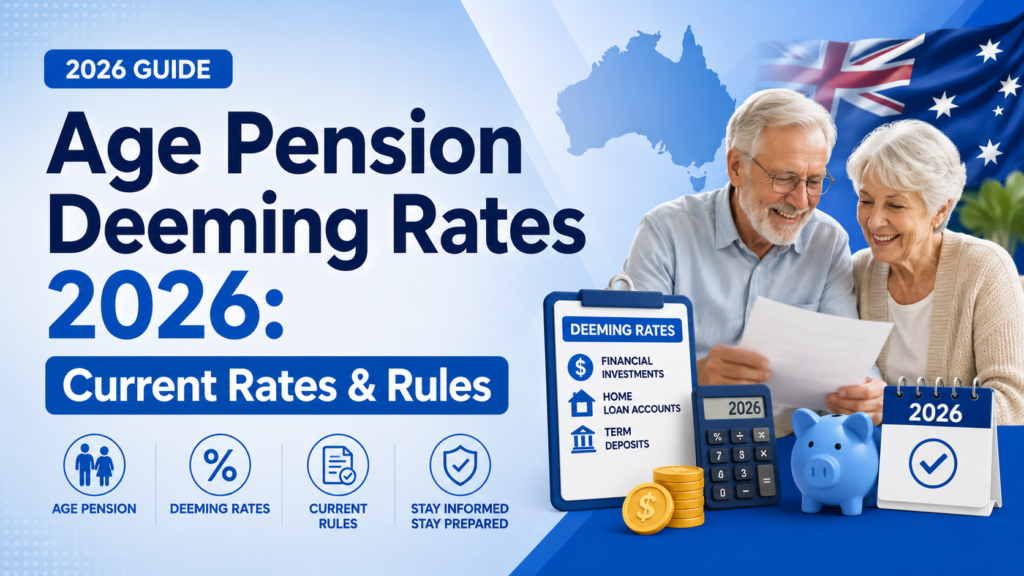
Age Pension Deeming Rates 2026: Current Rates & How They Work
One of the most confusing and frustrating moments for new retirees occurs when they sit down to apply for the Age Pension. They look at their bank account, which is earning a pitiful 1% interest, and yet Centrelink tells them that, according to the government’s calculations, they are earning a much higher “assumed” income from those savings.
Many pensioners feel like they are being cheated by a broken bureaucratic calculator. In reality, they are encountering one of the foundational pillars of the Australian welfare system: Deeming.
To determine if you are eligible for the Age Pension (and how much you will receive), Services Australia applies two tests: the Assets Test and the Income Test. Deeming is the specific set of rules used exclusively for the Income Test. Instead of constantly tracking exactly how much interest you earn on your bank accounts, or how much your shares went up or down this week, Centrelink simply assumes your financial assets are earning a fixed rate of return. This is the Deeming Rate.
Because these rates are set by the Minister for Social Services (often in response to Reserve Bank of Australia cash rate movements), understanding the 2026 tiers is vital for your financial planning.
In this comprehensive 2026 guide, we will break down the Age Pension Deeming Rates in plain English. We will explain why the system exists, outline the current lower and upper deeming thresholds for both singles and couples, detail exactly which financial assets are caught in the deeming net, and show you how to use this system to your advantage.
Key Takeaways
- Deeming is an Assumption: Centrelink doesn’t care what interest rate your bank actually pays you. They use a fixed “deeming rate” to assume what your investments are earning, simplifying the income test.
- The Tiered System: Deeming is not a flat tax. It uses a lower threshold (where a very small percentage rate is applied to your first chunk of savings) and an upper threshold (where a slightly higher rate is applied to the rest of your wealth).
- You Can Beat the System: If Centrelink deems your money is earning 2%, but you move your money into a high-interest term deposit earning 5%, you keep the extra 3% profit. Centrelink still only assesses you at 2%.
- Superannuation is Deemed: Once you reach Age Pension age, your superannuation balance is treated as a financial asset and is subject to deeming, even if you haven’t withdrawn a single dollar from it.
- The Family Home is Exempt: Your primary residence, your cars, and your household contents are physical assets. They are not financial assets and are completely exempt from deeming.
What is Deeming and Why Does Centrelink Use It?
Imagine if Centrelink had to assess the actual income of millions of pensioners every single fortnight. They would need you to upload statements every time your bank changed its interest rate by 0.1%, or every time a company you owned shares in paid a slightly larger dividend. The administrative burden on both the government and the pensioner would be catastrophic.
To solve this, the government invented Deeming.
Deeming is a standardized rule. It groups all your “financial assets” together (cash, shares, term deposits, superannuation) into one big pile. Centrelink then applies a fixed percentage rate to that pile to calculate a theoretical “deemed income.” This theoretical income is what they use for your Income Test.
The government uses deeming for three reasons:
- Simplicity: It removes the need for you to constantly report minor fluctuations in bank interest or stock dividends.
- Fairness: It ensures that two pensioners with $100,000 in savings are treated equally under the Income Test, regardless of whether one is a brilliant stock market investor and the other just leaves their money in a zero-interest checking account.
- Incentive: It encourages retirees to seek out better returns. If you know Centrelink is going to assess you as if you are earning 2%, it forces you to move your money out of a 0% checking account and into an investment that actually yields a return, helping you fund your own retirement.
The 2026 Deeming Rates (Lower & Upper Thresholds)
Deeming rates are tiered to protect people with smaller savings balances. The government applies a very low rate to the first chunk of your money (the lower threshold) and a higher rate to anything above that amount (the upper threshold).
(Note: Deeming rates are periodically frozen or adjusted by the Federal Government in response to economic conditions and the RBA cash rate. Always check the official Services Australia website for the exact percentages applicable on the day you apply. The figures below reflect the standard tiered structure applied to retirees).
Rates for Single Pensioners
If you are single and receiving an income support payment:
- The Lower Threshold: The first portion of your total financial assets (historically up to roughly $60,400) is deemed to earn the lower rate (e.g., 0.25%).
- The Upper Threshold: Any financial assets you hold over that threshold amount are deemed to earn the higher rate (e.g., 2.25%).
Rates for Pensioner Couples
If you are a member of a couple (living together or separated by illness), your financial assets are combined for the test:
- The Lower Threshold: The first portion of your combined financial assets (historically up to roughly $100,200) is deemed to earn the lower rate (e.g., 0.25%).
- The Upper Threshold: Any combined financial assets over that threshold amount are deemed to earn the higher rate (e.g., 2.25%).
To see exactly how these rates interact with your overall wealth, use our Benefits Calculator to estimate your potential pension rate.
Which Financial Assets are Deemed?
Centrelink casts a very wide net when defining “financial assets.” If it is a liquid asset that can generate a return, it will be added to your deeming pile.
The following assets are subject to the deeming rules:
- Cash and Bank Accounts: Savings accounts, checking/transaction accounts, and term deposits. Even if the money is sitting in a vault earning 0%, it is deemed.
- Superannuation (Post-Pension Age): Once you reach Age Pension age (currently 67), your superannuation balance is deemed as a financial asset, regardless of whether it is in accumulation phase or if you have rolled it over into an Account-Based Pension (income stream).
- Shares and Securities: Direct shares listed on the ASX or international exchanges, bonds, and debentures. Centrelink deems the total market value of the shares; they do not assess the actual dividends you receive.
- Managed Investments: Managed funds, unlisted property trusts, and ETF balances.
- Gifts (Over the Limit): If you gift more than $10,000 in a single financial year (or $30,000 over 5 years) to your children, the excess amount is treated as a “deprived asset” and is deemed to earn income for the next 5 years, even though you no longer have the money.
- Loans You Make to Others: If you loan $50,000 to your child to help them buy a house, that $50,000 is still considered your financial asset and is deemed, regardless of whether your child pays you interest.
Which Assets are NOT Deemed?
It is equally important to understand what is entirely excluded from the deeming rules. Physical, non-financial assets are assessed under the Assets Test, but they do NOT generate deemed income.
The following are exempt from deeming:
- Your Principal Home: The house you live in and the surrounding land (up to 2 hectares) is completely exempt from both the Assets and Income (deeming) tests.
- Physical Assets: Your car, boat, caravan, and household furniture.
- Superannuation (Pre-Pension Age): If you are under Age Pension age (e.g., you are 62 and receiving the Disability Support Pension), your superannuation balance is completely exempt from deeming, provided it remains in the accumulation phase and you are not drawing a pension from it.
- Investment Properties: The capital value of an investment property is not deemed. Instead, the actual net rental income (rent received minus allowable deductions like interest and maintenance) is assessed directly under the Income Test.
How Deeming Affects Your Age Pension Income Test
The Age Pension is calculated using two tests: the Assets Test and the Income Test. Centrelink runs both tests and pays you the lower of the two results.
Deeming only applies to the Income Test. Here is how the math works in practice (using standard illustrative figures):
Scenario: You are a single pensioner with $200,000 in a term deposit. You have no other income (no job, no rental properties).
- Centrelink looks at your $200,000 financial asset pool.
- They apply the lower deeming rate (e.g., 0.25%) to the first $60,400. That generates $151 of deemed income per year.
- They apply the upper deeming rate (e.g., 2.25%) to the remaining $139,600. That generates $3,141 of deemed income per year.
- Your total deemed income is $3,292 per year, or roughly $126 per fortnight.
Under the Age Pension Income Test, a single pensioner can generally earn up to a specific “Income Free Area” (e.g., $204 per fortnight) before their pension is reduced. Because your deemed income of $126 is below the $204 threshold, your Age Pension is not reduced by a single cent under the Income Test. (Though your $200,000 would still be assessed under the separate Assets Test).
Deeming vs Actual Returns: Who Wins?
The deeming system presents a massive financial opportunity for savvy retirees. Because Centrelink ignores your actual returns, you can significantly boost your lifestyle without losing your pension.
The Golden Rule: If your investments earn a higher interest rate than the Centrelink deeming rate, you keep the extra profit.
For example, if the upper deeming rate is set at 2.25%, but you shop around and place your money in a high-yield term deposit earning 5%, Centrelink only assesses your income at 2.25%. That extra 2.75% profit goes straight into your pocket and does not trigger the Income Test taper rate. This is why financial advisors constantly urge retirees to seek out the best possible secure yields for their cash.
Conversely, if you leave $100,000 in a standard checking account earning 0% interest, Centrelink still assumes you are earning 2.25%. You are losing money to inflation, and Centrelink is reducing your pension as if you were making a profit. You are losing on both fronts.
Deeming Exemptions (Failed Investments)
There are very rare situations where the Minister for Social Services will grant an exemption from the deeming rules. This almost exclusively applies to failed financial products.
If you invested money in a managed fund or a company that goes into liquidation or has its assets completely frozen by regulators, you can apply for a deeming exemption. If approved, Centrelink will acknowledge that you cannot access the money and it is not generating a return, and they will stop applying the deeming rate to that specific asset. This is a complex process and usually requires formal documentation from the liquidator.
For help navigating these complex appeals, review our Government Application Support Guide.
Frequently Asked Questions
Do I need to tell Centrelink when my bank changes its interest rate?
No. That is the beauty of the deeming system. You do not need to update Centrelink regarding interest rate fluctuations on your savings accounts or term deposits. You only need to update Centrelink via your myGov account if the actual balance (the total amount of money) in the account changes significantly.
Are deeming rates used for the Commonwealth Seniors Health Card (CSHC)?
Yes. To qualify for the CSHC, you must pass an income test (there is no assets test). Centrelink uses the exact same deeming rules to calculate the income generated by your Account-Based Pensions (superannuation) when assessing your eligibility for the CSHC.
How often do Deeming Rates change?
Historically, the Minister for Social Services reviews the rates periodically, usually in response to significant movements in the Reserve Bank of Australia (RBA) cash rate. However, the government has occasionally implemented multi-year “freezes” on deeming rates to protect pensioners from sudden income test shocks during periods of rapid interest rate hikes.
Is my physical cash in a safe at home deemed?
Yes. Physical cash (money hidden under the mattress or in a safe) is still classified as a financial asset. You are legally required to declare it to Centrelink, and it will be added to your financial asset pool and subjected to the standard deeming rates, even though it physically cannot earn interest in your house.
Official Resources
Because the government can unfreeze or adjust deeming rates and thresholds, you must verify the exact percentages directly via official channels:
- Services Australia – Deeming Rules and Current Rates
- Services Australia – Age Pension Income Test
- myGov Portal
Conclusion
While the concept of Age Pension Deeming Rates initially feels like bureaucratic overreach—assuming you are earning money you might not be—it is actually the cornerstone of a simplified, predictable welfare system. By removing the need to constantly report minor dividend and interest fluctuations, deeming allows you to manage your retirement without living in fear of a Centrelink debt notice every time the stock market twitches.
More importantly, understanding the tiered deeming thresholds unlocks a significant financial strategy for retirees. Because Centrelink caps the rate at which they assess your investments (e.g., at the 2.25% upper threshold), the system actively rewards you for finding higher-yielding investments. If you secure a 5% term deposit, the government effectively ignores the extra profit.
By keeping a close eye on your total financial asset pool, maximizing your actual returns above the deemed rate, and utilizing tools like our Benefits Calculator, you can master the Age Pension Income Test and ensure you are squeezing every possible dollar out of your hard-earned retirement.
Disclaimer
PublicServicesDesk.com is an independent informational website and is not affiliated with, endorsed by, or operated by the Australian Government, Services Australia, Centrelink, Medicare, MyGov, the Australian Taxation Office (ATO), or the Department of Home Affairs. Information is provided for general educational purposes only and may change over time. Always verify important details through official Australian Government websites before making decisions or submitting applications.