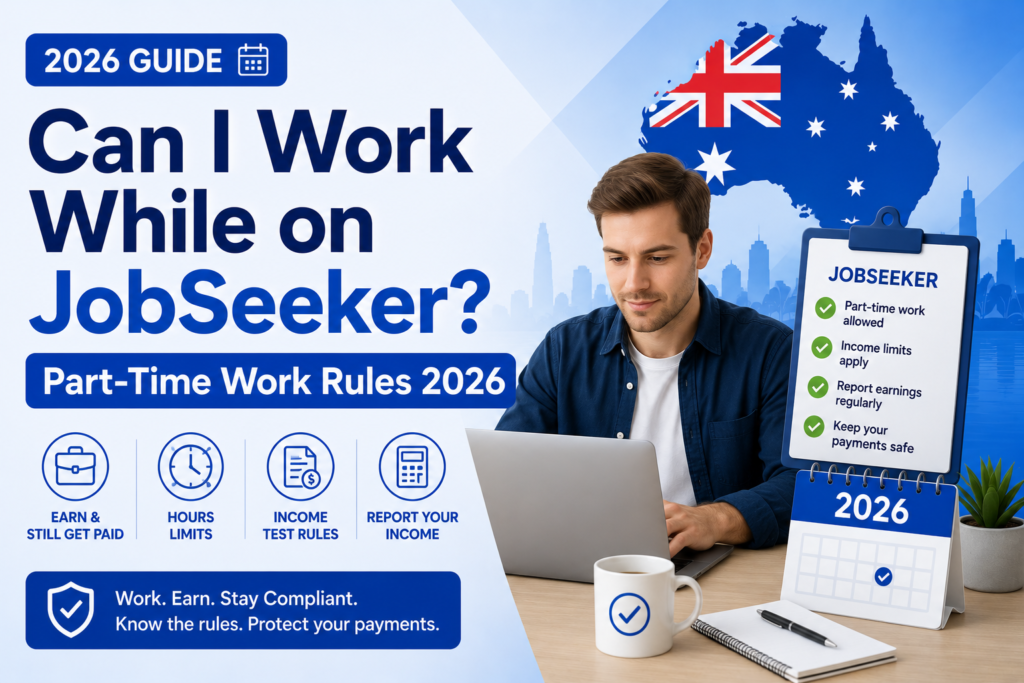
Can I Work While on JobSeeker? Part-Time Work Rules 2026
One of the most persistent and damaging myths in the Australian welfare system is the belief that securing a job will instantly trigger the cancellation of your Centrelink support. Because of this fear, many people on the JobSeeker Payment turn down casual shifts or part-time roles, terrified that earning a few hundred dollars will leave them stranded without a safety net.
This raises the critical question: Can I work while on JobSeeker?
The answer is a resounding, absolute yes. In fact, the entire system is actively designed to encourage you to take on part-time, casual, or short-term contract work. Services Australia uses a graduated system that slowly reduces your payment as you earn more, ensuring that mathematically, you are always financially better off taking the shifts than you would be sitting at home.
However, while the financial benefits are guaranteed, taking on employment introduces rigorous new administrative responsibilities. You must understand how your wages interact with the Income Test, how working alters your “Mutual Obligation” job search requirements with Workforce Australia, and exactly how to report your gross income to avoid triggering a debt.
In this comprehensive 2026 guide, we will break down the rules of working part-time while on JobSeeker. We will explain the Income Free Area, the Working Credit system, how to renegotiate your Job Plan, and what happens to your Centrelink claim if you successfully land a full-time career.
Key Takeaways
- Work is Encouraged: You can work casually, part-time, or run your own small business while receiving JobSeeker. Your payment will not be automatically cancelled just because you got a job.
- The Income Free Area: You can earn a specific baseline amount of money every fortnight (historically around $150) without your Centrelink payment reducing by a single cent.
- Reduced Job Searches: If you secure substantial part-time hours, you can negotiate with your employment provider to drastically reduce (or completely eliminate) the number of jobs you must apply for each month.
- Reporting is Mandatory: Once you start working, your survival depends on accurately reporting your Gross income (before tax) to Centrelink every 14 days. Read our JobSeeker Reporting Income Guide for a full walkthrough.
- The 12-Week Safety Net: If you get a high-paying full-time job, your JobSeeker drops to $0. But Centrelink keeps your claim “open” for 12 weeks. If the job doesn’t work out, your payments instantly restart without needing to reapply.
Can I Work While on JobSeeker?
Yes. The JobSeeker Payment is designed as a transitional support system, not a permanent destination. The ultimate goal of the Department of Employment and Workplace Relations (and Services Australia) is to transition you into sustainable, full-time employment.
Because finding a perfect full-time job immediately is rare, the government actively pushes recipients to accept casual shifts, holiday temp work, or part-time roles. This is because part-time work maintains your skills, builds your resume, keeps you socially connected, and often leads directly to full-time offers from the same employer.
To facilitate this, the system is designed so that you are never penalized for working. Even if your Centrelink payment is reduced because of your wages, the combination of your (Wages + Reduced Centrelink) will always be a higher dollar amount than (Centrelink alone).
How Part-Time Work Affects Your Payment
The moment you start earning money, your payment becomes dynamic. It will fluctuate based on how many hours you work each fortnight. To understand the precise mathematics, you can dive deep into our JobSeeker Income Test Explained article, or use our Benefits Calculator to estimate your specific situation.
The Income Test and Taper Rates
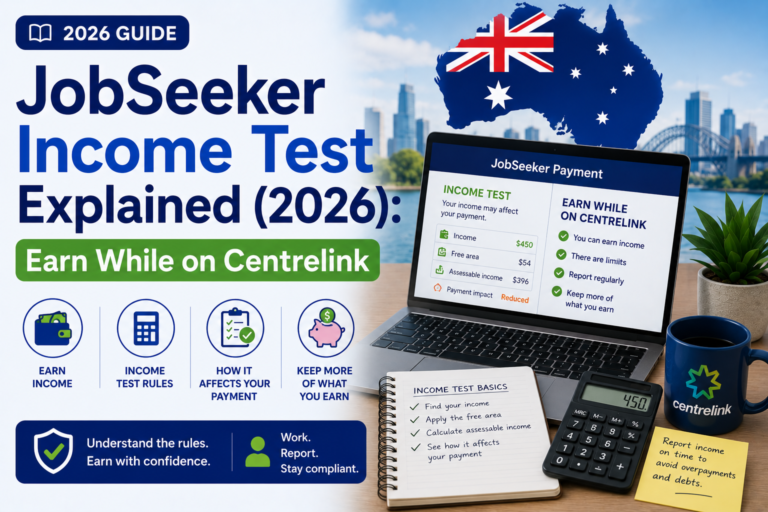
Centrelink uses an “Income Free Area.” This means you can earn a certain amount of gross wages each fortnight (for example, $150) without it affecting your JobSeeker payment at all.
Once you earn more than the Income Free Area, a “taper rate” applies. For every dollar you earn above the threshold, your JobSeeker payment is reduced by 50 cents, and eventually 60 cents. You still keep the wages you earned from your boss, but your Centrelink payment shrinks slightly to balance it out.
The Working Credit Shield
If you have been unemployed for a few months, you will have built up a stockpile of Working Credits (up to 1,000 credits). These act as a protective shield.
If you get a short-term contract and earn $800 in a fortnight, Centrelink would normally slash your payment. However, if you have 800 Working Credits saved up, Centrelink drains those credits instead of touching your payment. This means for that specific fortnight, you get to keep your massive $800 wage AND your absolute maximum JobSeeker payment. It is a massive financial reward for taking on short-term work.
How Work Changes Your Mutual Obligations
When you are fully unemployed, your “Job Plan” (managed by your Workforce Australia provider) usually requires you to apply for a large number of jobs per month (e.g., 20 jobs) and attend regular appointments.
Working part-time changes this drastically.
The government operates on an “hours-based” mutual obligation system. If you secure part-time work, you must immediately contact your employment provider and show them your employment contract or payslips. Your Job Plan will be renegotiated.
- Partial Reduction: If you are working 15 hours a week, your provider will significantly reduce your required job searches (e.g., dropping from 20 to 10 or 5 jobs a month) because you are already actively participating in the workforce.
- Full Exemption (Fully Meeting Requirements): If you work enough hours (typically 70+ hours a fortnight, though this varies based on your age and assessed work capacity), you are considered to be “fully meeting your mutual obligations.” Your job search target drops to zero. You do not have to look for any other work, you don’t have to attend provider appointments, but you still receive a partial JobSeeker payment to top up your low wages.
The Absolute Necessity of Reporting
Taking a job triggers the most strict administrative requirement in the welfare system: Income Reporting.
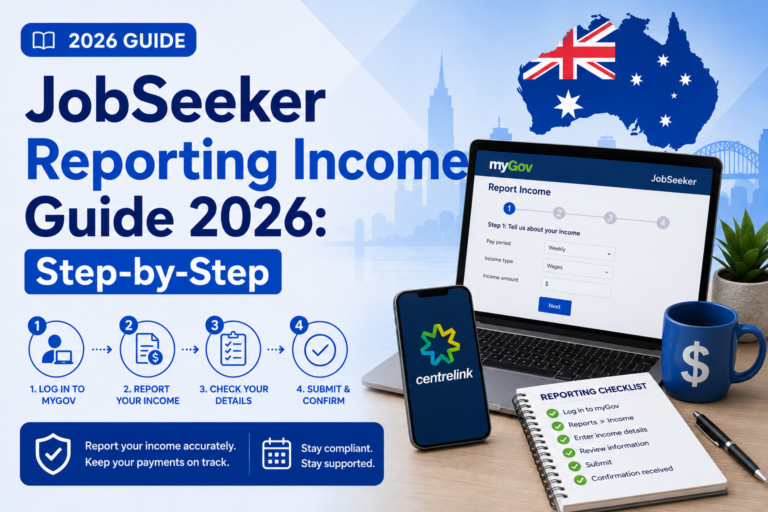
You must log into your myGov account or use the Express Plus Centrelink app every 14 days on your designated reporting date. You must declare:
- The exact number of hours you worked during those 14 days.
- The exact Gross Income (before tax) you were physically paid by your employer during those 14 days.
If you fail to report, your JobSeeker payment is suspended. If you report your “Net” income (what hit your bank account) instead of your “Gross” income, you will eventually receive a Centrelink debt notice. For a full tutorial on this, read our JobSeeker Reporting Income Guide.
What Happens if I Find Full-Time Work?
If you land a fantastic full-time job paying $80,000 a year, your fortnightly wages will vastly exceed the upper limits of the Income Test. When you report this massive income, your JobSeeker payment for that fortnight will be reduced to exactly $0.
Do not cancel your Centrelink claim!
Centrelink places you in a “Zero Rate Period.” If your payment drops to $0 due to employment income, your JobSeeker claim remains active in the background for up to 6 consecutive fortnights (12 weeks).
This is a vital safety net. Many new jobs fall through during the probation period. If you are fired or the business goes under during those 12 weeks, your JobSeeker payments will automatically restart the moment you report zero income again. You do not have to endure the agonizing 4-week waiting period of applying for a brand new claim.
If you maintain the full-time job and report $0 Centrelink entitlement for 12 straight weeks, your claim will then officially be cancelled.
Step-by-Step: Transitioning into a New Job
If you have just been offered a part-time role, follow these steps to protect your welfare safety net:
- Accept the Job: Take the position and get your employment contract and start date.
- Notify Your Provider: Call or email your Workforce Australia provider. Tell them you have secured part-time work. Ask them to immediately update your Job Plan to reduce your monthly job search targets so you don’t get penalized while working.
- Prepare for Reporting: Note down your Centrelink reporting date. Download the Express Plus App if you haven’t already.
- Collect Payslips: Ensure your employer gives you a formal payslip outlining your Gross Income and Tax Withheld within one working day of paying you.
- Report Accurately: On reporting day, enter your Gross wages and hours worked.
If you are struggling with the digital reporting portals, review our Government Application Support Guide.
Common Mistakes to Avoid
- Quitting Without Good Reason: If you accept a part-time job and then voluntarily quit two weeks later because you “didn’t like the vibe,” Centrelink can apply an 8-week non-payment penalty. You cannot voluntarily leave suitable employment while on welfare without a severe medical or safety justification.
- Hiding Cash Jobs: Thinking “it’s only 4 hours of cash-in-hand babysitting, I won’t report it” is a criminal offense. Centrelink relies on public tip-offs and bank monitoring. Report all income, no matter how small.
- Failing to Report Partner Income: If you have a spouse who also got a part-time job, you must report their gross wages on your Centrelink reporting day, as the Partner Income Test applies to your JobSeeker payment.
Frequently Asked Questions
Can I start my own business while on JobSeeker?
Yes. You can operate as a sole trader or start a small business. However, business income reporting is highly complex. You usually have to provide profit and loss statements every 3 months. You should ask your provider about the Self-Employment Assistance program (formerly NEIS), which provides specialized support and protects your JobSeeker payment while you build your business.
Do I get to keep my Health Care Card if I work?
Yes. As long as your JobSeeker claim remains active (even if you are in a Zero Rate period where your payment is $0 due to high wages), you generally retain your Health Care Card, allowing you to access cheaper medications and bulk-billing doctors.
What if my employer pays me monthly, but Centrelink is fortnightly?
You must adhere to Centrelink’s “Paid” rule. If you receive a massive monthly paycheck on the 15th, you report that entire gross amount in the Centrelink fortnight that covers the 15th. This will likely reduce your JobSeeker to $0 for that specific fortnight, but your payment will return to normal in the following fortnight when you report $0 income.
Can Centrelink force me to take a job I hate?
Yes, to an extent. If your employment provider refers you to “suitable paid employment” and you refuse the job offer without a valid medical, safety, or severe logistical reason (like a 3-hour commute each way), your JobSeeker payment can be suspended or cancelled entirely.
Official Resources
For the most current rules regarding mutual obligations and income reporting, always refer directly to the government:
Conclusion
The answer to “Can I work while on JobSeeker?” is a definitive yes. The system is fundamentally built to support your transition back into the workforce. Taking on a few casual shifts or a permanent part-time role will not only increase your weekly bank balance, but it will dramatically reduce the stress of your mutual obligation job search requirements.
The key to seamlessly integrating part-time work with welfare is meticulous administration. You must communicate proactively with your Workforce Australia provider to ensure your Job Plan accurately reflects your new working hours. Furthermore, you must embrace the discipline of reporting your Gross Income accurately every 14 days via myGov.
By understanding how the Income Free Area and Working Credits protect your earnings, you can confidently accept any shifts offered by an employer, knowing that the 12-week Zero Rate safety net will catch you if the employment falls through.
Disclaimer
PublicServicesDesk.com is an independent informational website and is not affiliated with, endorsed by, or operated by the Australian Government, Services Australia, Centrelink, Medicare, MyGov, the Australian Taxation Office (ATO), or the Department of Home Affairs. Information is provided for general educational purposes only and may change over time. Always verify important details through official Australian Government websites before making decisions or submitting applications.