Home > Centrelink > Disability Support Pension Guide
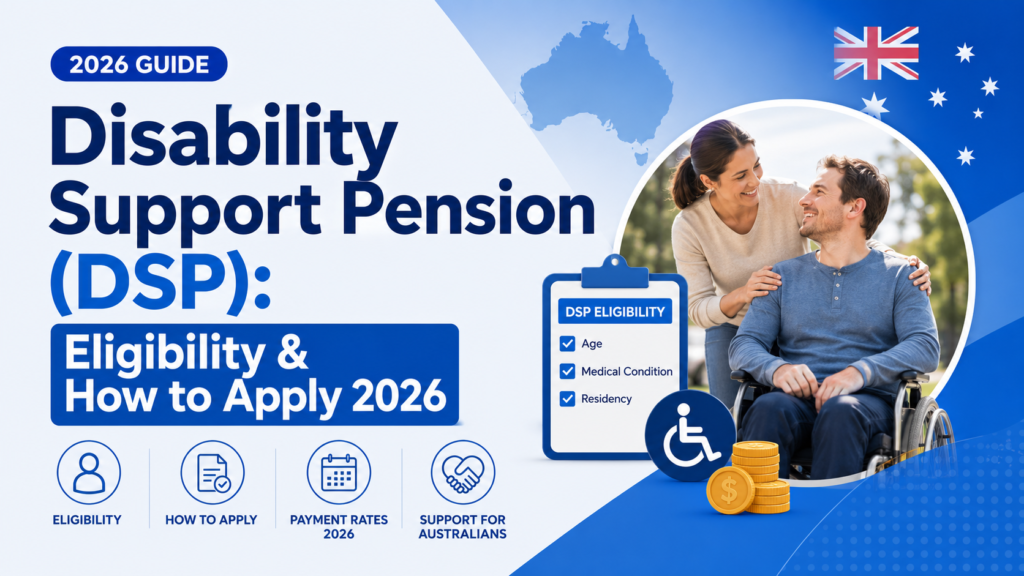
Disability Support Pension (DSP): Eligibility & How to Apply 2026
The Disability Support Pension (DSP) is arguably the most vital financial safety net in the Australian welfare system. It is designed to provide long-term income support for individuals who suffer from a physical, intellectual, or psychiatric condition that permanently prevents them from working.
Because the DSP pays significantly more than unemployment benefits and carries fewer mutual obligation requirements, it is heavily guarded by Services Australia. It is notoriously the hardest Centrelink payment to secure. Over the last decade, the rejection rate for new DSP applications has hovered around 60% to 70%.
Most applicants are rejected not because they aren’t genuinely sick or disabled, but because they fail to understand the rigid, highly specific legal and medical definitions Centrelink uses. A simple letter from your lifelong GP stating “My patient is too ill to work” will result in an automatic rejection. To be approved, you must prove that your condition is “fully diagnosed, treated, and stabilised,” you must score a minimum of 20 points on the bureaucratic Impairment Tables, and you must provide clinical evidence from accredited specialists.
In this comprehensive 2026 guide, we will break down the labyrinthine DSP application process. We will explain exactly what medical evidence is actually required, how the points system works, what to expect during a Job Capacity Assessment (JCA), and what you should do to survive financially while you wait months for a decision.
Key Takeaways
- Diagnosed, Treated, and Stabilised: This is the golden rule. You cannot get the DSP if you are waiting for a new surgery next month, or if you haven’t tried the standard medical treatments for your condition. Centrelink must be convinced you will not get better in the next two years.
- The Impairment Tables: Your condition is rated on a points system. You must score at least 20 points to qualify.
- The Program of Support Trap: If you don’t score all 20 points on a single impairment table, you must prove you actively participated in a “Program of Support” (rehabilitation/job training) for at least 18 months before applying.
- Specialists are Mandatory: For conditions like mental health, a GP diagnosis is invalid. You must have a report from a Clinical Psychologist or Psychiatrist.
- Working Capacity: You must be medically assessed as being unable to work for 15 hours or more per week for the next two years.
What is the Disability Support Pension (DSP)?
The DSP is an income support payment for people aged between 16 and Age Pension age (currently 67). It is paid at the higher “Pension” rate, making it more generous than the JobSeeker Payment.
To qualify for the DSP, you must pass two distinct sets of criteria:
- Non-Medical Rules: You must meet Australian residency requirements (including a 10-year qualifying residence period for migrants, with some exceptions) and pass the standard Centrelink Income and Assets tests.
- Medical Rules: You must suffer from a physical, intellectual, or psychiatric impairment that restricts your ability to work.
Note: If you are permanently blind, you are automatically eligible for the DSP, and you are exempt from the Income and Assets tests. You simply need to provide an ophthalmologist report.
The Golden Medical Rule: Diagnosed, Treated, and Stabilised
If you fail to meet this single rule, Centrelink will reject your application without even looking at your points.
For Centrelink to accept your condition as permanent, it must be:
- Fully Diagnosed: A recognized medical specialist must have formally diagnosed the condition. (e.g., A GP suspecting you have Autism is not a diagnosis. A Clinical Psychologist formally diagnosing it is).
- Fully Treated: You must have undertaken all reasonable, standard medical treatments for your condition. If a doctor says a standard spinal surgery or a course of chemotherapy has an 80% chance of fixing your condition, you generally must undergo that treatment before claiming the DSP.
- Fully Stabilised: Your medical team must state that your condition is unlikely to significantly improve within the next two years, regardless of further treatment.
Example of Rejection: You injure your back at work. You apply for the DSP three months later. Your GP notes you are starting intensive physiotherapy next month. Centrelink will reject the DSP because your condition is not yet “treated and stabilised”—it might improve after the physiotherapy.
Understanding the 20-Point Impairment Tables
Centrelink does not care what the name of your disease is; they only care about how the disease impairs your daily functioning.
To measure this, they use 15 different Impairment Tables (e.g., Table 1 for Functions requiring Physical Exertion, Table 5 for Mental Health, Table 8 for Communication).
You must score at least 20 points across these tables. Your doctors must specifically reference these tables in their reports.
The Program of Support Requirement (The 20-Point Trap)
There is a massive legislative trap hidden in the points system.
If you score 20 points on a single Impairment Table (which means your condition is considered “Severe”), you bypass the Program of Support requirement.
However, many people have multiple, moderate illnesses. For example, you might score 10 points for a bad back (Table 1) and 10 points for severe depression (Table 5). This gives you a total of 20 points.
Because you did not get 20 points on a single table, the law dictates you must have actively participated in a Program of Support (a government-funded rehabilitation or disability employment service) for at least 18 months in the three years prior to applying. If you haven’t done those 18 months of rehab, you will be rejected, even with 20 points.
Medical Evidence: Why GP Letters Aren’t Enough
The vast majority of DSP applications are rejected because the applicant submits a pile of GP sick notes and standard hospital discharge summaries.
Centrelink requires explicit, detailed Treating Doctor Reports that align precisely with the Impairment Tables. Furthermore, the diagnosis must come from a specialist for specific conditions:
- Mental Health (Psychiatric): Must be diagnosed by a Psychiatrist or a Clinical Psychologist. A standard GP diagnosis of depression or anxiety is legally invalid for the DSP.
- Intellectual Disability: Must be assessed by a Psychologist using standardized IQ testing.
- Hearing/Vision: Must be assessed by an Audiologist, ENT specialist, or Ophthalmologist.
Your specialist should explicitly write in their report: “The condition is fully diagnosed, treated, and stabilised. It is unlikely to significantly improve in the next 24 months. I rate the functional impairment as 20 points under Impairment Table 5.”
The Job Capacity Assessment (JCA)
If your medical evidence looks solid, Centrelink will schedule a Job Capacity Assessment (JCA). This is an interview (usually by phone, sometimes in person) with a government-employed allied health professional (like an occupational therapist, psychologist, or physiotherapist).
The goal of the JCA is to determine two things:
- Do they agree with your doctor’s assessment of your Impairment points?
- What is your capacity to work?
To get the DSP, the assessor must conclude that, even with employer modifications or retraining, you cannot work 15 hours or more per week independently in the open labor market.
Tip for the JCA: Be brutally honest. Do not put on a brave face. Describe your condition on your absolute worst days. If you pretend you are coping well, the assessor will conclude you have the capacity to work 15 hours a week.
Income and Assets Tests
Like the Age Pension, the DSP is subject to standard means testing. (You can use our Benefits Calculator to check thresholds).
- Assets Test: The value of everything you own (excluding your principal family home) is assessed. If you have massive savings or investment properties, your DSP will be reduced or cut off.
- Income Test: If you or your partner earn income, your DSP is reduced via a taper rate.
Step-by-Step: How to Apply via myGov
The application is lengthy. Take your time and gather your evidence before clicking submit.
- Consult Your Specialists: Do not apply until you have hard copies of specialist reports stating you are diagnosed, treated, and stabilised, and referencing the Impairment Tables.
- Prepare your myGov Account: Ensure your Centrelink is linked. If not, see our myGov Account Setup Checklist.
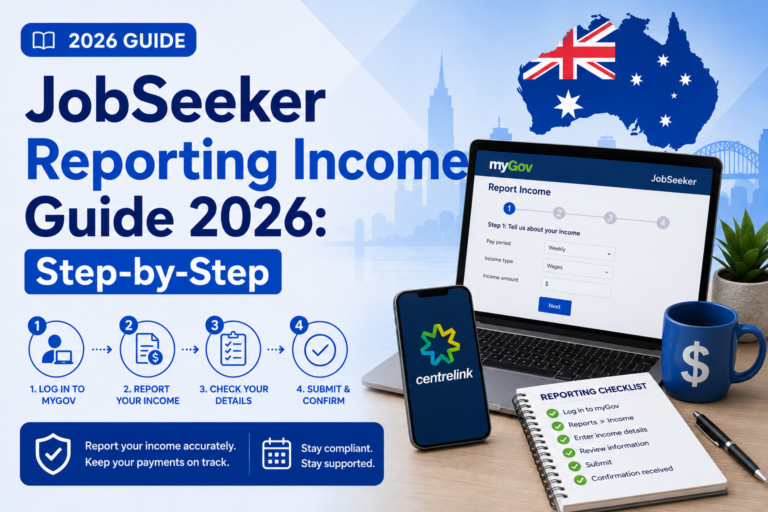
- Start the Claim: Log into myGov, go to Centrelink, select “Make a Claim”, and choose “Disability Support Pension”.
- Fill out the Questionnaire: The digital form will ask extensive questions about your living arrangements, assets, and medical history.
- Upload Documents: You must upload your primary medical reports. Ensure the scans are clear and readable.
- Submit and Wait: DSP applications are highly complex and must be reviewed by specialized teams. Processing times frequently exceed 3 to 6 months.
For help with digital uploads, check our Government Application Support Guide.
What to Do While Waiting (JobSeeker Exemptions)
You cannot survive for 6 months with $0 income while Centrelink processes your DSP claim.
The standard procedure is to apply for the JobSeeker Payment at the exact same time you apply for the DSP. JobSeeker processes much faster (usually a few weeks).
To avoid being forced to attend job interviews while you are severely disabled, you must submit a Centrelink Medical Certificate (Form SU415) completed by your GP. This certificate grants you a temporary exemption from mutual obligations while your DSP claim is being decided. You must continuously renew this medical certificate (usually every 3 months) until the DSP decision is finalized.
Common Rejections and How to Appeal
With a 70% rejection rate, you should be prepared for a denial.
If you are rejected, Centrelink will send a letter explaining why (e.g., “You only scored 10 points,” or “Your condition is not fully stabilised”).
You have the legal right to appeal the decision by requesting a review by an Authorised Review Officer (ARO). This is free. The smartest strategy is to read the rejection reason, go back to your specialist, get a new, more detailed report specifically rebutting Centrelink’s reason for rejection, and submit that new evidence to the ARO.
Frequently Asked Questions
Can I work part-time while on the DSP?
Yes. You can work up to 29 hours a week and remain on the DSP, though your payment will be reduced by the Income Test taper rate based on how much you earn. If you work 30 hours or more per week, your DSP will be suspended.
Does the NDIS replace the Disability Support Pension?
No. They are entirely separate systems doing different things. The DSP provides you with money to buy food and pay rent (Income Support). The NDIS provides funding to buy wheelchairs, hire support workers, and modify your home (Disability Services). Being approved for one does not automatically guarantee approval for the other.
Can I travel overseas while on the DSP?
Generally, you can only travel overseas for a maximum of 28 days (4 weeks) in a 12-month period before your DSP is stopped. There are rare exceptions (Portability Extensions) if you are traveling for acute medical treatment that is not available in Australia, or if you are assessed as having a severely impaired life expectancy.
Can my partner get the Carer Payment if I am on the DSP?
Yes. If you are on the DSP, your partner can apply for the Carer Payment to support you, provided they meet the strict “constant care” rules and income tests for that specific payment.
Official Resources
Because the medical rules are highly complex, you and your doctor must review the official Impairment Tables before applying:
- Services Australia – Disability Support Pension
- Department of Social Services – Official Impairment Tables
- myGov Portal
Conclusion
The Disability Support Pension (DSP) is arguably the most protective welfare payment in Australia, providing long-term security and automatic access to Medicare benefits and concession cards. However, the application process is a grueling bureaucratic marathon designed to filter out anyone who has any capacity to participate in the workforce.
Success relies entirely on the quality of your medical evidence. You must move past standard GP certificates and engage clinical specialists who understand Centrelink’s unique language. If your medical reports do not explicitly state that your condition is “fully diagnosed, treated, and stabilised,” and if they do not map your symptoms directly to a 20-point score on the Impairment Tables, your application will fail.
By preparing meticulously, surviving the financial waiting period via JobSeeker and medical certificates, and being prepared to forcefully appeal a rejection through an Authorised Review Officer, you can successfully navigate this complex system and secure the financial support you genuinely deserve.
Disclaimer
PublicServicesDesk.com is an independent informational website and is not affiliated with, endorsed by, or operated by the Australian Government, Services Australia, Centrelink, Medicare, MyGov, the Australian Taxation Office (ATO), or the Department of Home Affairs. Information is provided for general educational purposes only and may change over time. Always verify important details through official Australian Government websites before making decisions or submitting applications.