Home > Centrelink > Carer Payment Care Rules Guide
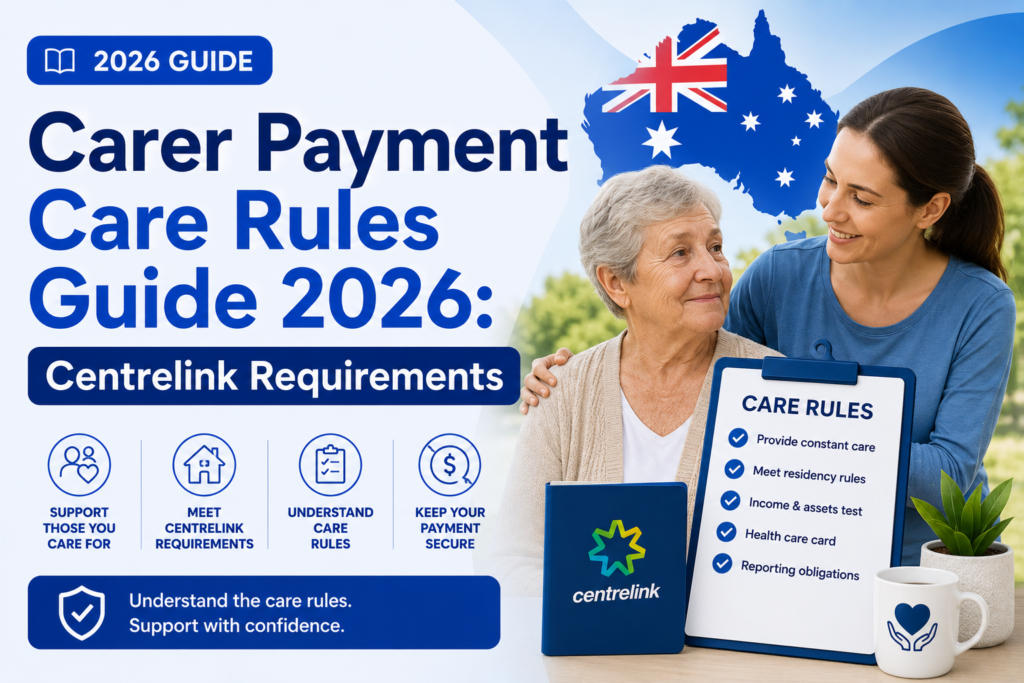
Carer Payment Care Rules Guide (2026): Strict Centrelink Requirements Explained
Sacrificing your career to provide full-time care for a loved one with a severe disability, medical condition, or frail age is an act of immense devotion. To prevent full-time caregivers from falling into poverty, the Australian Government provides the Carer Payment. This is a primary income support payment, acting as a direct substitute for a wage, ensuring that those providing critical care can afford basic living expenses.
However, securing this payment is notoriously difficult. Because the Carer Payment acts as an absolute replacement for a full-time job, Services Australia applies incredibly strict legal definitions regarding exactly how much care you provide, and what kind of care is required.
Many applicants mistakenly assume that simply driving an elderly parent to medical appointments or doing their weekly grocery shopping qualifies them for the payment. It does not. The Department of Home Affairs operates on the doctrine of “Constant Care.” Furthermore, the rules govern not only your actions but also the medical severity of the person you are caring for, enforcing strict limits on how many hours you can be away from them each week.
In this comprehensive 2026 guide, we will break down the complex Carer Payment Care Rules. We will define exactly what “constant care” means in the eyes of Centrelink, explain the rigid 25-hour limit for work and study, outline the specific medical thresholds the care receiver must meet (such as the ADAT test), and explain how you can take legal “Respite” days without your payments being cut off.
Key Takeaways
- ‘Constant Care’ is Mandatory: You must provide care for a significant period every single day. Centrelink explicitly views this as the equivalent of a normal working day. It must physically prevent you from engaging in full-time employment.
- The 25-Hour Rule: You are legally permitted to temporarily cease caring to work, study, or volunteer for a maximum of 25 hours per week. Crucially, this 25 hours includes the time you spend traveling to and from the activity.
- Medical Severity: It is not enough that you want to care for them; a doctor must certify they require it. The person receiving care must score highly on the Adult Disability Assessment Tool (ADAT) or have a terminal illness.
- Respite Days: Caregiver burnout is real. Centrelink allows you to take up to 63 days of “respite” (a total break from caring) every calendar year without your payments stopping.
- Living Arrangements: While you do not strictly have to live in the exact same house as the person you care for, proving you provide “constant care” while living in separate residences requires overwhelming documentary evidence and is frequently rejected.
Understanding the Carer Payment vs Carer Allowance
Before diving into the complex care rules, it is vital to distinguish between the two primary Centrelink carer benefits, as they have entirely different sets of rules.
1. Carer Payment: This is an income support payment (similar to the Age Pension or JobSeeker). It is means-tested and paid to individuals who provide “constant care.” Because it replaces a full-time wage, it has incredibly strict rules regarding your employment and daily schedule.
2. Carer Allowance: This is a supplementary, smaller fortnightly payment. It is not income-tested (though there is a high combined income limit of $250,000). It does not require you to provide “constant care.” You can work a 40-hour full-time job and still receive the Carer Allowance, provided you offer daily care and attention (like helping with medication or preparing evening meals).
This guide specifically details the rigorous rules required for the Carer Payment.
The Core Rule: What is ‘Constant Care’?
The entire legislative foundation of the Carer Payment rests on the phrase “constant care.” If an assessing officer decides you are not providing constant care, your claim will be rejected immediately.
According to Services Australia, constant care means you provide care for a “significant period every day.” This level of care must be equivalent to a normal working day (roughly 7 to 8 hours minimum per day).
Crucially, the care must be physically necessary to protect the safety, hygiene, or basic living requirements of the care receiver. Constant care includes:
- Assisting with personal hygiene (showering, toileting).
- Physical mobility assistance (lifting into beds or wheelchairs).
- Constant supervision to prevent the person from harming themselves due to cognitive impairment (e.g., severe Dementia or Alzheimer’s).
- Administering complex daily medical routines.
What is NOT constant care?
If your primary duties consist of doing their weekly grocery shopping, mowing their lawn, driving them to a doctor’s appointment twice a week, and calling them on the phone to check in, you are not providing constant care. You are providing domestic assistance. Centrelink will reject your claim.
Rules Regarding the Person You Care For (The ADAT)
Your willingness to provide care is irrelevant if the government does not legally recognize that the person actually needs that level of care.
To qualify for the Carer Payment, the person receiving care must have a severe disability, a severe medical condition, or be frail aged. They must also meet Centrelink residency rules and pass an income and assets test (their wealth matters as well as yours).
To prove the severity of the medical condition, Centrelink uses a standardized scoring system called the Adult Disability Assessment Tool (ADAT) (or a similar tool for children under 16).
Passing the ADAT
The ADAT consists of two parts:
- The Claimant Questionnaire: You fill this out, answering questions about how much help the person needs with daily tasks (eating, walking, communicating, cognitive behavior).
- The Treating Health Professional Report: The care receiver’s primary doctor (GP or specialist) must complete a rigorous medical assessment detailing their clinical impairments.
To receive the Carer Payment, the combined ADAT score from both questionnaires must meet a minimum threshold (currently a score of at least 25, with a minimum score of 10 coming directly from the doctor’s assessment). If the doctor states the person is relatively independent, the score will be low, and your claim for Carer Payment will fail, regardless of how much time you actually spend helping them.
The 25-Hour Rule (Work and Study Limits)
Because you must provide constant care, you cannot engage in full-time employment. However, recognizing that carers need social connection and extra income to survive, the legislation allows for Temporary Cessation of Care.
You are permitted to step away from your caregiving duties to participate in paid employment, voluntary work, education, or training for a maximum of 25 hours per week.
The Travel Time Trap
The most devastating aspect of this rule is that the 25 hours includes your travel time. It calculates the entire duration you are absent from the person you are caring for.
If you work a 20-hour a week job, but it takes you 45 minutes to catch the bus to work and 45 minutes to get home (1.5 hours travel per shift x 4 shifts = 6 hours travel), your total absence is 26 hours. You have breached the rules, and your Carer Payment will be cancelled.
To see how your wages from these 25 hours will reduce your payment, you can use our Benefits Calculator.
Providing Care in the Same Home vs Different Homes
Historically, you had to live in the exact same house as the person you were caring for to receive the Carer Payment. The rules have relaxed slightly, but “living apart” remains a major hurdle.
You can now receive the Carer Payment if you live in a different home, provided you live adjacent to or in the same neighborhood as the care receiver.
However, if you live apart, the burden of proof is heavily placed on you to explain exactly how you manage to provide “constant care” (equivalent to a full working day) while maintaining two separate households. If you live a 45-minute drive away, Centrelink will logically conclude that you are not providing constant, daily supervision and will reject the claim.
Respite Rules: Taking a Break (The 63-Day Allowance)
Caregiver burnout is a severe physical and mental health crisis. Centrelink legally recognizes that you need a break to survive this role.
You are allowed to take up to 63 days of “Respite” every calendar year (Jan 1 to Dec 31) without your Carer Payment being stopped.
During these 63 days, you can completely cease caring. You can go on a holiday, visit friends interstate, or simply stay home and rest while another family member takes over the care duties. You must notify Centrelink via myGov when you are using your respite days.
Hospitalization Rules: What Happens if They Are Admitted?
If the person you care for is admitted to the hospital, you are technically no longer providing “constant care” because the hospital nursing staff has taken over that duty.
However, Centrelink will not immediately cut off your payment. The person you care for can spend up to 63 days in the hospital per calendar year, and you will continue to receive your Carer Payment during this time.
If their hospital stay extends beyond 63 days, you must apply to Centrelink for a special extension, which is usually only granted if you can prove you are still spending every single day at the hospital actively assisting the nurses with their personal care.
Documents Required: Medical Reports
Failing to provide correct medical documentation is the primary reason Carer Payment applications stall for months.
You will need:
- Claimant Form: The massive application form detailing your daily routine.
- Medical Report (ADAT): This must be completed by the care receiver’s treating doctor. It cannot be filled out by you. Ensure the doctor understands the gravity of this form; vague answers will result in a low ADAT score and a rejection.
- Identity Documents: Proof of identity for both you and the person receiving care.
- Financial Details: Bank statements for both you and the person receiving care to pass the Assets Test.
For advice on uploading these documents securely, read our Government Application Support Guide.
Step-by-Step Process: How to Apply
- Check Eligibility: Ensure both you and the care receiver meet the basic income and residency rules.
- Gather Medical Evidence: Download the ADAT medical forms and book a long appointment with the care receiver’s GP to get them filled out accurately.
- Start the Claim: Log into your myGov account and link Centrelink.
- Lodge Online: Select “Make a Claim” and choose Carer Payment. The wizard will walk you through the questions regarding your living arrangements and the care you provide.
- Upload Documents: Attach clear scans of the ADAT medical report, your ID, and your financial statements.
- Wait for Assessment: Complex care claims require human intervention and cannot be auto-processed.
Common Mistakes and Application Refusals
- Failing to Mention Travel Time: When asked how many hours you work per week, many carers say “20” and forget to mention their 6-hour commute. Centrelink investigates, discovers the travel time pushes them over 25 hours, and cancels the payment.
- Vague ADAT Forms: A doctor writing “Patient is elderly and needs help” will score zero points. The doctor must explicitly state “Patient cannot bathe independently, cannot dress independently, and cannot prepare meals.”
- Applying for Payment instead of Allowance: If you work full-time (40 hours), do not waste months applying for the Carer Payment. You will be rejected immediately. Apply for the Carer Allowance instead.
Frequently Asked Questions
Can multiple people share the Carer Payment?
Yes. If two people share the care of one person (e.g., two siblings caring for a parent), you can apply for a ‘Shared Care’ arrangement. However, the Carer Payment is split between you; you do not both receive the maximum full payment.
What happens if the person I care for goes into an aged care home?
If the person you care for permanently moves into a residential aged care facility, you are no longer providing constant care. You must notify Centrelink immediately. Your Carer Payment will stop (usually after a short grace period of 14 weeks), and you will likely need to transition to the JobSeeker Payment or Age Pension.
Do I get Rent Assistance on the Carer Payment?
Yes. If you pay rent in the private rental market (or pay site fees for a caravan/mobile home) and your rent exceeds the minimum threshold, you are eligible for Rent Assistance in addition to your base Carer Payment.
What is the Carer Supplement?
The Carer Supplement is an automatic annual lump sum payment (usually $600) paid in July to eligible recipients of the Carer Payment or Carer Allowance, intended to help with the extra costs of caring.
Official Resources
For the most current ADAT forms, income thresholds, and official policy regarding constant care, always refer directly to the government portal:
Conclusion
The Carer Payment is an indispensable lifeline for Australians who have halted their careers to care for vulnerable family members. However, the system is designed to act as a strict replacement for full-time employment, and as such, it demands uncompromising adherence to the Centrelink Care Rules.
The concept of “constant care” is the defining hurdle. You must prove, through meticulous medical documentation via the ADAT, that your loved one genuinely requires daily, intensive supervision and physical assistance. You must rigorously protect your eligibility by never exceeding the 25-hour weekly limit for work and travel, and you must communicate clearly with Centrelink when utilizing your 63 days of respite or during hospital admissions.
By understanding these strict parameters before you apply, ensuring the treating doctor completes the medical reports accurately, and managing your ongoing reporting correctly via myGov, you can secure and maintain this vital financial support without fear of sudden cancellations or debts.
Disclaimer
PublicServicesDesk.com is an independent informational website and is not affiliated with, endorsed by, or operated by the Australian Government, Services Australia, Centrelink, Medicare, MyGov, the Australian Taxation Office (ATO), or the Department of Home Affairs. Information is provided for general educational purposes only and may change over time. Always verify important details through official Australian Government websites before making decisions or submitting applications.