Youth Allowance Independence Rules Guide: How to Prove Your Status in 2026
For young Australians applying for Youth Allowance, there is one single word that has the power to dramatically change the amount of financial support they receive: Independent.
By default, Centrelink assumes that anyone under the age of 22 is financially “dependent” on their parents. This means your parents’ income and assets are heavily scrutinized under the Parental Income Test, often resulting in severe reductions to your fortnightly payments—even if your parents do not actually give you any money. To bypass this frustrating barrier, you must prove to the government that you are financially and socially independent.
Achieving independent status is the holy grail for many students and job seekers. Once classified as independent, Centrelink stops asking about your parents’ tax returns. Your payment is assessed solely on your personal income and assets, and you gain access to the highest possible base rates, plus valuable supplements like Rent Assistance.
However, the Youth Allowance Independence Rules are notoriously strict, complex, and heavily audited. You cannot simply tick a box claiming you live out of home. You must meet specific, legislated criteria and back it up with a mountain of evidence. In this comprehensive guide, we will break down exactly how you can qualify for independence in 2026, whether through full-time work, relationship status, or special circumstances like it being unreasonable to live at home (UTLAH).
Key Takeaways
- Automatic Independence: You automatically become independent the moment you turn 22. At this age, you transition to the JobSeeker Payment if you are looking for work, or remain on Youth Allowance (Independent) if studying full-time.
- Work-Based Rules: The most common path for school leavers is supporting themselves through full-time work (averaging 30 hours a week for 18 months).
- Regional Concessions: Students from regional or remote areas face lower earning thresholds to prove work-based independence, designed to help them relocate for university.
- UTLAH Provisions: If you are forced to leave home due to extreme family breakdown, domestic violence, or severe health risks, you can be classified as independent immediately under the ‘Unreasonable to Live at Home’ rules.
- Evidence is Mandatory: Centrelink requires rigid proof—payslips, group certificates, marriage certificates, or social worker reports—before granting independent status.
What Does “Independent Status” Mean?
In the eyes of Centrelink, “independence” is a legal and financial classification. It means the Australian Government accepts that you are entirely self-sufficient, or that your parents are completely incapable of supporting you. The core outcome of this classification is the total removal of the Parental Income Test.
A common misconception is that merely moving out of your parents’ house makes you independent. This is incorrect. If you move out of home to attend university but do not meet the strict independence criteria, Centrelink still views you as dependent. They will assess your parents’ income and may reduce your payment accordingly, even while you pay your own rent.
To see how your current circumstances align with the rules, we recommend utilizing our Youth Allowance Checker before compiling your paperwork.
Age-Based Independence
The simplest and most straightforward way to achieve independence requires absolutely no paperwork: you simply have to get older.
Under current legislation, you automatically gain independent status on the day you turn 22 years of age.
- If you are a Job Seeker, your Youth Allowance will cease when you turn 22, and you will automatically be transitioned to the JobSeeker Payment, which has no parental income testing.
- If you are a Full-Time Student or Apprentice, you can remain on Youth Allowance until you turn 25, but the moment you turn 22, the parental income test is permanently removed from your file.
Work-Based Independence Criteria
For school leavers who do not want to wait until they turn 22, proving that you have supported yourself through employment is the most common path to independence. This is frequently referred to as taking a “gap year” (though it usually requires more than a standard year of work).
The Standard 18-Month Rule
To satisfy the standard work criteria, you must prove that since leaving secondary school, you have supported yourself through full-time paid employment. The specific requirement is that you have worked an average of 30 hours per week for at least 18 months during any 2-year period.
This does not mean you have to work exactly 30 hours every single week. It is an average over the 18 months. You can work 40 hours one week and 20 hours the next. However, you must meticulously track your hours, as Centrelink will demand PAYG summaries, payslips, and a letter from your employer verifying the exact hours worked.
Concessions for Regional and Remote Students
The government recognizes that students from regional, rural, and remote areas face significant financial burdens when relocating to a city for university. To assist, there are special concessions that make it easier for these students to prove work-based independence.
If your family home is located in an inner regional, outer regional, remote, or very remote area (as defined by the official geographic classification maps), you may only need to meet one of the following reduced requirements:
- You have earned a specific threshold amount (e.g., 75% of the National Training Wage Schedule) in an 14-month period since leaving school.
- You have worked part-time (at least 15 hours a week) for at least 2 years since leaving school.
Additionally, for the regional concession to apply, your parents’ combined income must be below a specific threshold (historically around the $160,000 mark, plus an allowance for additional children). If your parents earn more than this, you cannot use the regional concession and must rely on the standard 18-month rule.
Relationship and Family-Based Independence
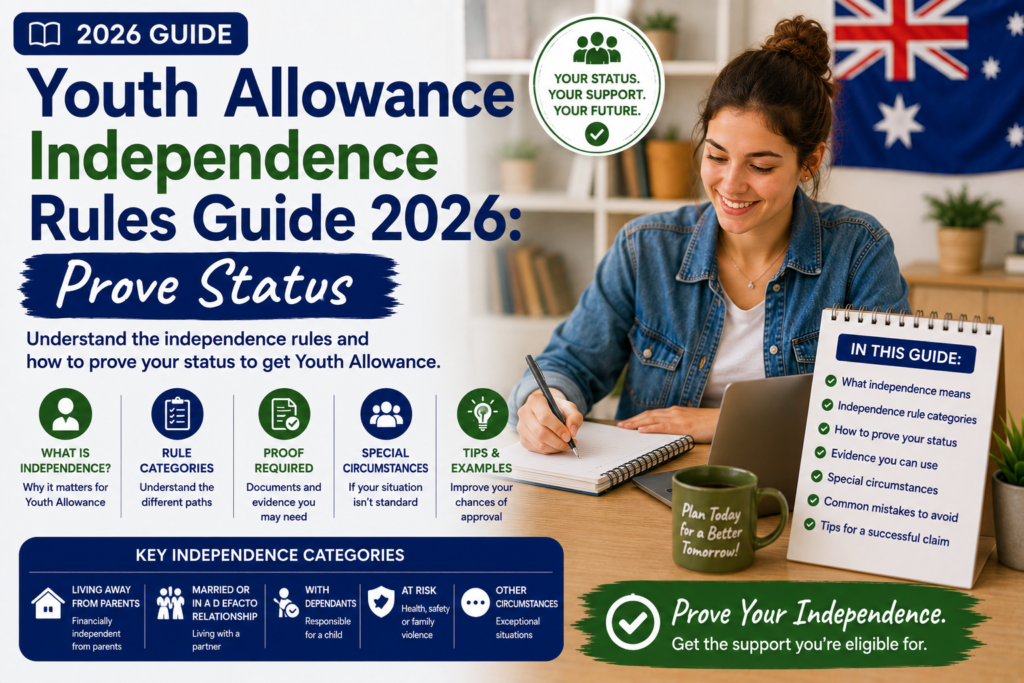
Your relationship status can instantly classify you as independent, regardless of your work history or age. You are considered independent if you meet any of the following criteria:
- You are married. (A legal marriage certificate is required).
- You have been in a registered relationship under state/territory law for at least 12 months.
- You are living in a long-term de facto relationship. You generally must prove you have lived with your partner for at least 12 months (or 6 months in special circumstances). Note: If you claim independence via a partner, you are no longer subject to the Parental Income Test, but you are subject to the Partner Income Test. Your partner’s income will dictate your Youth Allowance rate.
- You have, or have had, a dependent child. If you are a parent (whether the child lives with you or not, provided you had legal responsibility at some point), you are permanently classified as independent.
Special Circumstances: Unreasonable to Live at Home (UTLAH)
The most sensitive and complex path to independence is the Unreasonable to Live at Home (UTLAH) provision. This is designed to protect vulnerable young people who are forced out of their family home due to unsafe environments.
You can be granted independent status immediately under UTLAH if you cannot live with your parents due to:
- Extreme family breakdown.
- Domestic violence, physical abuse, emotional abuse, or sexual abuse.
- Severe risks to your physical or mental health and well-being.
- Your parents refusing to allow you to live at home (and refusing to provide any financial support).
The UTLAH Assessment Process: Claiming UTLAH is not a simple checkbox. When you apply under this provision, you will be assigned a Centrelink social worker. The social worker will conduct a detailed, confidential interview with you. They will also generally need to verify your story. This usually requires third-party evidence, such as reports from police, school counselors, psychologists, doctors, or community leaders. In many cases, the social worker may also attempt to contact your parents to verify the breakdown, though they will not do this if it puts your safety at risk.
If you are applying under these circumstances, we strongly advise reading our Application Support Guide to understand the privacy protections in place.
Other Independence Criteria
Beyond the common pathways, there are several specific situations where Centrelink automatically grants independence:
- Orphans: Both of your parents are deceased.
- Refugees: You hold a specific refugee visa and your parents do not live in Australia.
- Care Leavers: You are or were previously in state or territory out-of-home care (foster care).
- Parents in Prison or Nursing Homes: Both of your parents are incarcerated, or residing in nursing homes/psychiatric institutions long-term.
The Financial Benefits of Being Independent
Why go through all the paperwork to prove independence? The financial benefits are substantial.
- No Parental Income Test: Your parents could earn $500,000 a year, and it will not reduce your payment by a single cent.
- Maximum Base Rate: The base rate for an independent single person living away from home is significantly higher than the dependent rate.
- Access to Rent Assistance: Independent recipients who pay rent in the private market are eligible to apply for Rent Assistance, which provides extra fortnightly cash to cover housing costs. Dependent students living away from home only get rent assistance under very specific circumstances.
To see exactly how much you could receive as an independent, use our Benefits Calculator.
Step-by-Step Process: How to Apply
Applying for independent status is done concurrently with your Youth Allowance claim. Here is the process:
- Initiate the Claim: Log into your myGov account and begin a Youth Allowance claim. If you haven’t linked your accounts yet, follow our Guide to Linking Centrelink to myGov.
- Answer the Questionnaire Honestly: The online claim wizard will ask adaptive questions about your living situation, work history, and relationship status. Based on your answers, the system will identify if you are attempting to claim independence.
- Trigger the Independence Module: If you claim you have worked for 18 months, or if you claim you cannot live at home, the system will open a specific “Independence” module requiring detailed dates and explanations.
- Upload Rigorous Evidence: At the end of the claim, the checklist will demand specific proofs. You must upload these directly to the portal.
- Wait for Manual Assessment: Independence claims are never automatically approved by algorithms. They are always placed in a queue for a human assessing officer to review. UTLAH claims are routed to social workers.
Documents Required to Prove Independence
The success of your claim hinges entirely on your documents. A lack of evidence is the number one reason independence claims are rejected.
- For Work-Based Independence: You need every single payslip covering the 18-month (or regional concession) period. You need PAYG Payment Summaries/Income Statements. Most importantly, you need a signed, official letter from your employer(s) explicitly stating your start and end dates and the exact number of hours worked per week.
- For Relationship Independence: A certified copy of your Marriage Certificate, or a Certificate of Registration of a Relationship from your state government. For de facto, you need joint lease agreements, joint utility bills, and statutory declarations from friends/family verifying the relationship duration.
- For UTLAH: A completed ‘Unreasonable to Live at Home’ form (which you fill out), plus a ‘Third Party Statement’ form filled out by an independent professional (doctor, teacher, police officer, counselor) verifying the family breakdown.
- General Identity: Standard ID documents, tax file numbers, and bank details.
Processing Times and Common Mistakes
Because independence claims require manual human verification, the processing times are generally longer than standard dependent claims.
If you submit a perfect application with flawless evidence, expect to wait between 4 to 8 weeks. However, if there are discrepancies in your work hours, or if the social worker needs to investigate an UTLAH claim, processing can take months. If you are in extreme financial hardship during this wait, you must call Centrelink to request urgent processing.
Common Mistakes to Avoid:
- Estimating Work Hours: Guessing that you worked “about 30 hours” will result in a rejection. You must provide exact documentary proof of the hours.
- Relying Only on Cash Jobs: Centrelink rarely accepts “cash in hand” jobs as proof of self-supporting employment because there is no paper trail or tax record.
- Ignoring the myGov Inbox: If Centrelink requires a clearer copy of a payslip, they will send a task to your myGov inbox. If you don’t respond within 14 days, the claim is cancelled.
Frequently Asked Questions
Does moving out of my parents’ house make me independent?
No. Simply moving out, paying your own rent, and buying your own groceries does not satisfy Centrelink’s legal definition of independence. Unless you meet the age, work, relationship, or UTLAH criteria, you are still classified as dependent, and your parents’ income will be assessed.
If my parents refuse to give me money, am I independent?
Not automatically. Centrelink’s stance is that parents have a responsibility to support their children. If your parents simply refuse to give you their tax details or financial support out of stubbornness, Centrelink will still view you as dependent and may reject your claim. You would need to prove extreme family breakdown under the UTLAH rules to bypass this.
Can I use part-time work to prove independence?
If you are relying on the standard 18-month rule, you must average 30 hours a week, which Centrelink defines as full-time. However, if you qualify for the regional and remote student concessions, you may be able to use part-time work (at least 15 hours a week for 2 years) to prove independence.
How do I prove a de facto relationship for independence?
You must provide concrete evidence that you have lived together in a genuine domestic relationship for at least 12 months. This includes joint lease agreements, joint bank accounts showing shared expenses, utility bills in both names, and statutory declarations from third parties.
Official Resources
For the most current legislative rules and to download the required forms, always refer to the official government channels:
Conclusion
Achieving independent status for Youth Allowance is transformative. It strips away the complex, often restrictive Parental Income Test, unlocking higher base payment rates and opening the door to Rent Assistance. It provides true financial autonomy as you transition into full-time study or the workforce.
However, the burden of proof rests entirely on your shoulders. Whether you are claiming independence through grueling months of full-time work, navigating the complexities of a regional concession, or surviving an unreasonable living situation at home, your success dictates that you are methodical, organized, and honest in your application.
Ensure you gather every single payslip, secure solid third-party documentation, and engage with the digital tools provided via myGov. By understanding the Youth Allowance Independence Rules inside and out, you position yourself to secure the vital financial support you rightfully deserve.
Disclaimer
PublicServicesDesk.com is an independent informational website and is not affiliated with, endorsed by, or operated by the Australian Government, Services Australia, Centrelink, Medicare, MyGov, the Australian Taxation Office (ATO), or the Department of Home Affairs. Information is provided for general educational purposes only and may change over time. Always verify important details through official Australian Government websites before making decisions or submitting applications.