Home > Centrelink > Parental Income Test Guide
Centrelink Parental Income Test Guide: Everything You Need to Know in 2026
For many young Australians embarking on tertiary education or searching for their first full-time job, Centrelink payments serve as a vital financial lifeline. However, applying for these benefits often introduces families to one of the most complex and frequently misunderstood assessment processes operated by the Australian Government: the Parental Income Test.
If you are applying for Youth Allowance or ABSTUDY as a dependent, your eligibility—and the exact amount of money you will receive each fortnight—is heavily dictated by how much your parents or guardians earn. The Parental Income Test is the mechanism Services Australia uses to calculate this figure. It evaluates your family’s combined financial resources to determine if they are in a position to financially support you, or if you require government assistance.
Navigating this test can be a source of immense frustration. It requires meticulous coordination between the applicant and their parents, the gathering of specific tax documents, and an understanding of complex terms like “assessable income,” “fringe benefits,” and the “Family Pool.” A single mistake on a form can delay your payments for weeks.
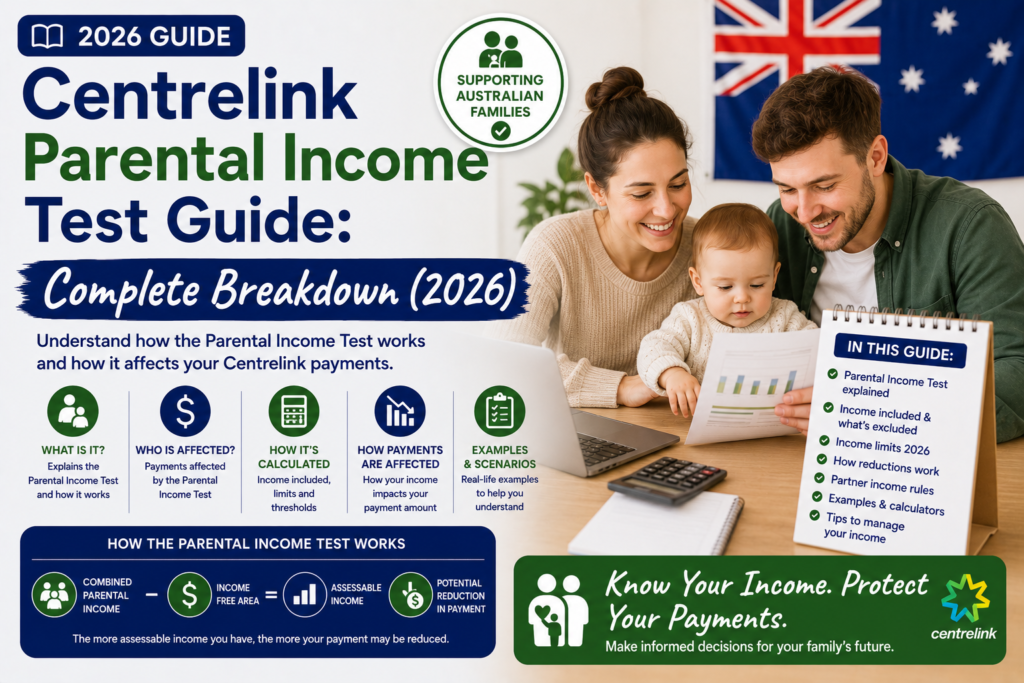
In this comprehensive Parental Income Test Guide, we will break down exactly how the test works, who is subject to it, what income is counted, the specific forms your parents need to fill out, and how to bypass common delays. Whether you are a school leaver, a parent trying to help your child apply, or an apprentice, this guide will provide the clarity you need.
Key Takeaways
- Dependency Status is Crucial: The Parental Income Test only applies if Centrelink considers you a “dependent.” If you can prove you are independent, your parents’ income is irrelevant.
- Combined Income is Assessed: The test looks at the combined taxable income of both parents/guardians, plus other specific factors like employer fringe benefits and net investment losses.
- Income Thresholds: There is a base income threshold. If your parents earn below this amount, your payment is not reduced. For every dollar earned above the threshold, your Youth Allowance reduces gradually until it hits zero.
- The Family Pool Matters: If you have siblings who also receive certain Centrelink payments or who are supported by your parents, the impact of your parents’ income on your payment is lessened through the “Family Pool” mechanism.
- ATO Integration: The most efficient way for parents to provide their income details is by providing their Tax File Number (TFN) so Centrelink can securely verify their income directly with the ATO.
What is the Parental Income Test?
The Parental Income Test is a financial assessment conducted by Services Australia to determine the level of financial support a dependent young person should receive. The underlying principle of the test is that if a family earns a substantial income, they have the capacity to financially support their young adult children through university, apprenticeships, or while they are looking for work. Conversely, families with lower incomes receive more government support to ensure their children have equal access to educational and employment opportunities.
When you apply for a dependent payment, the test assesses your parents’ combined Adjusted Taxable Income (ATI) from the “base tax year.” Typically, the base tax year is the financial year that ended in the previous calendar year. For example, if you apply in February 2026, Centrelink will look at your parents’ income from the 2024–2025 financial year.
It is important to note that the Parental Income Test is just one part of the equation. As an applicant, you must also pass your own Personal Income Test and Personal Assets Test. If you work a part-time job, your own earnings will also be assessed and may reduce your payment. To see how multiple factors might affect your overall entitlement, you can use our Benefits Calculator.
Who Does the Parental Income Test Apply To?
The Parental Income Test strictly applies to individuals whom Centrelink classifies as dependent. This categorization is not necessarily about whether you still live at home; it is a rigid legal definition based on age, marital status, and employment history.
You are generally subject to the Parental Income Test if you are applying for:
- Youth Allowance for Students and Australian Apprentices (and you are under 22 years of age).
- Youth Allowance for Job Seekers (and you are under 22 years of age).
- ABSTUDY (if you are a dependent Aboriginal or Torres Strait Islander student or apprentice).
Dependent vs. Independent Status
The fastest way to bypass the Parental Income Test is to prove that you are independent. If you are deemed independent, Centrelink will not ask for your parents’ income details, and their wealth will have absolutely zero impact on your payments.
You are automatically considered independent if you are 22 years of age or older. (At age 22, students stay on Youth Allowance but become independent, while job seekers transition to the JobSeeker Payment). You can also be classified as independent if you meet specific criteria, such as:
- You have supported yourself through full-time employment for a specific duration (usually averaging 30 hours a week for at least 18 months in a two-year period).
- You are married or in a registered relationship.
- You have, or have had, a dependent child of your own.
- You are a refugee without parents living in Australia.
- It is unreasonable for you to live at home due to extreme family breakdown, violence, or severe health risks.
If you are unsure of your status, you can utilize our Youth Allowance Checker to help determine if you are likely to be classified as dependent or independent before you begin the lengthy application process.
How It Works: Income Thresholds and Reductions
The Parental Income Test is not a simple “pass or fail” system. Instead, it operates on a sliding scale based on an established income threshold. These thresholds are indexed regularly by the government.
The Base Threshold
There is a baseline combined parental income threshold (for example, historically around the $60,000 to $65,000 mark, though this changes annually). If your parents’ combined Adjusted Taxable Income is below this threshold, their income will not affect your payment at all. You will be entitled to the maximum base rate of Youth Allowance, assuming you also pass your personal income and assets tests.
The Taper Rate (How Payments Reduce)
If your parents’ combined income is above the threshold, your Youth Allowance will be reduced. This reduction is applied using a “taper rate.” For every dollar your parents earn over the base threshold, your fortnightly payment is reduced by a specific number of cents (typically 20 cents for every dollar over the limit).
This reduction continues as parental income rises, eventually reaching a cut-off point. Once your parents’ income hits this upper cut-off limit, your Youth Allowance reduces to $0, and you are no longer eligible for financial assistance. The exact cut-off point varies wildly depending on whether you live at home or away from home to study, and whether you have siblings (the Family Pool).
What Income is Included in the Assessment?
One of the most common mistakes families make is assuming that Centrelink only looks at the “Taxable Income” figure on their ATO Notice of Assessment. In reality, Centrelink assesses Adjusted Taxable Income (ATI), which includes several other financial components. This prevents wealthy families from using complex tax deductions to appear artificially poor on paper.
When calculating the Parental Income Test, Centrelink adds together the following for both parents/guardians:
- Taxable Income: Your gross income minus allowable tax deductions. This is the baseline figure reported to the Australian Taxation Office (ATO).
- Reportable Fringe Benefits: If an employer provides perks instead of cash salary (like a company car, paid rent, or school fee payments), these are added back into the income assessment if they exceed a certain threshold.
- Target Foreign Income: Any income earned overseas that is not taxable in Australia.
- Net Investment Losses: If your parents have negatively geared investment properties or financial investments (where the costs/interest exceed the rental income/dividends), the loss they claimed on their tax return is added back to their income.
- Tax-Free Pensions and Benefits: Certain non-taxable government pensions or defense force payments.
- Reportable Employer Superannuation Contributions: Extra superannuation contributions made by an employer as part of a salary sacrifice arrangement are added back.
Child support paid out by your parents for a child from a previous relationship is deducted from their total ATI.
Understanding the “Family Pool”
The “Family Pool” is a critical concept that actually benefits larger families. The government recognises that a family earning $100,000 with one child has significantly more disposable income than a family earning $100,000 trying to support three teenage children.
When applying the Parental Income Test taper reduction, Centrelink looks at the “pool” of dependent children in the family. The pool includes:
- The applicant (you).
- Any siblings who are also receiving dependent Youth Allowance, ABSTUDY, or Assistance for Isolated Children.
- Any younger siblings aged 15 to 19 who are in secondary school.
- Any children for whom the parents receive Family Tax Benefit (Part A).
If there are multiple children in the family pool, the total reduction caused by the parents’ income is shared among them. For example, if the parents’ income dictates a $100 fortnightly reduction, but there are two dependent university students in the family pool, each student’s Youth Allowance is only reduced by $50. This means parents with multiple dependent children can earn a much higher combined income before their children lose their Youth Allowance entirely.
Step-by-Step Process: How Parents Provide Details
For a dependent claim to be processed efficiently, the applicant and the parents must work together. A claim will stall indefinitely if the parents fail to provide their financial data. You can follow our Application Support Guide to help coordinate this paperwork.
Here is the standard step-by-step process:
- The Student Initiates the Claim: The student logs into their myGov account, navigates to Centrelink, and begins the Youth Allowance claim. During the claim, the student will be asked to provide their parents’ names and contact details.
- Parents Receive the Notification: If the student provides their parents’ Customer Reference Numbers (CRNs), the parents may receive a task directly in their own Centrelink online accounts. Alternatively, the student will be instructed to have their parents complete a specific form.
- Completing the Mod PT Form: The official form used to collect this data is the Parental Income Test Assessment (Mod PT) form. Parents can complete this digitally via their own linked Centrelink online account, or they can fill out a paper PDF and have the student upload it. Using the digital Digital Services portal is infinitely faster.
- Providing Tax File Numbers (TFNs): The absolute fastest and easiest way to satisfy the income test is for parents to provide their TFNs on the Mod PT form and authorize Centrelink to request their tax data directly from the ATO. If their tax returns for the base year have already been lodged and processed, Centrelink’s systems will instantly verify the income, bypassing human manual assessment entirely. For more on TFNs, visit our TFN category.
- Using an Estimate (If Tax is Not Yet Lodged): If the parents have not yet lodged their tax return for the base year (for instance, if they use a tax agent and have an extended deadline), they must provide a rigorous estimate of their Adjusted Taxable Income. They must also explain why their return hasn’t been lodged. Once the tax return is eventually lodged, Centrelink will automatically reconcile the difference. If the parents underestimated their income, the student may incur a debt and have to repay some Youth Allowance.
If your parents need help setting up their online access to complete this, send them our Guide to Linking Centrelink to myGov and our myGov Account Checklist.
Documents Required for Assessment
If parents choose to allow ATO data matching by providing their TFNs, they rarely need to upload physical documents. However, if they have complex financial structures, have not lodged their tax returns, or experienced a sudden drop in income, they will need to provide concrete evidence.
Documents that may be requested include:
- Notice of Assessment: The official document issued by the ATO after a tax return is processed.
- PAYG Payment Summaries / Income Statements: From employers.
- Business Financial Statements: If a parent is self-employed, runs a partnership, or is the director of a private company or trust, they will likely need to provide full profit and loss statements, balance sheets, and individual trust tax returns. (Note: Claims involving trusts and private companies are notoriously slow to process as they require specialized manual assessment by Centrelink’s complex assessment team).
- Proof of Separation: If your parents have separated recently, they must provide proof of the separation date, as only the income of the parent you live with (or who primarily supports you) will be assessed.
Common Mistakes That Delay Claims
The Parental Income Test is the primary cause of blown-out processing times for students. Avoid these frequent pitfalls to ensure a smooth application:
- Missing the Base Year Concept: Providing payslips for the current month instead of the official tax return for the required base financial year. Centrelink assesses historical annual income, not current weekly cash flow (unless applying for a current year assessment due to a drastic income drop).
- Failing to Declare Fringe Benefits: Parents often forget that their company car or salary-sacrificed laptop must be declared. When Centrelink eventually data-matches with the ATO and finds undeclared fringe benefits, the claim will be suspended and debts may be issued.
- Ignoring the “Tasks” Tab: Students often assume their claim is processing, while an urgent notification is sitting in their parents’ myGov inbox asking them to complete the Mod PT module. Both student and parents must check their accounts regularly.
- Unlodged Tax Returns: The biggest bottleneck. Encourage your parents to lodge their tax returns with the ATO as early as possible in the financial year if you plan to claim Youth Allowance.
Tips for a Smooth Assessment
To navigate the Parental Income Test without stress, we highly recommend following these proactive steps:
- Have ‘The Talk’ Early: Sit down with your parents months before you apply. Explain that their financial details are required by the government. Ensure they are comfortable providing this information, either directly to Centrelink or to you.
- Apply for the “Current Year Assessment” if Income Drops: If your parents earned a high income in the base tax year, but have since lost their job, retired, or experienced a massive drop in income, they can apply for a Current Tax Year Assessment. This forces Centrelink to use a current estimate rather than the historical high income, potentially qualifying you for payments immediately.
- Ensure All Accounts Match: Make sure the names, dates of birth, and TFNs provided match exactly with what the ATO has on file. A simple spelling mistake in a parent’s name will break the automated ATO data link, forcing a human review and a multi-week delay.
- Understand Siblings’ Impact: If you have siblings applying for university next year, be aware that when they enter the “Family Pool,” your Youth Allowance payment might actually increase because the parental income reduction is now shared between two students.
Frequently Asked Questions
What happens if my parents refuse to provide their income details?
If you are classified as dependent and your parents refuse to complete the Parental Income Test or provide their financial details, your Youth Allowance claim will be rejected. Centrelink cannot assess your entitlement without this information. If you are experiencing extreme family breakdown, you may need to apply for ‘unreasonable to live at home’ independent status.
Are my parents’ assets (like their house or savings) assessed?
No. Under current Centrelink legislation, the Family Assets Test for Youth Allowance has been removed. Only your parents’ Adjusted Taxable Income is assessed. However, your own personal assets (your savings, your car) are subject to the Personal Assets Test.
My parents are divorced. Whose income is assessed?
If your parents are separated or divorced, Centrelink generally only assesses the income of the parent you live with, or the parent who provides the most financial support. If that parent has a new partner (your step-parent), the step-parent’s income is also included in the assessment.
What is the exact income threshold before my payment is reduced?
The base parental income threshold changes annually on January 1st due to indexation. For the most precise and up-to-date threshold figures, you should utilize our Benefits Calculator or check the official Services Australia website. The family pool size will determine the upper cut-off limit.
Do my parents have to fill out the form every year?
Generally, yes. Centrelink conducts an annual reassessment of parental income, usually around September or October. If your parents provided their TFNs and authorized data matching, Centrelink will simply update their income automatically from the ATO. If not, they will be asked to provide new estimates or notices of assessment.
Conclusion
The Centrelink Parental Income Test is a necessary hurdle for dependent students and job seekers seeking financial assistance. While the forms and terminology can seem daunting at first glance, the underlying concept is straightforward: it ensures that government support is directed toward young Australians whose families genuinely lack the financial capacity to support them.
By understanding what constitutes Adjusted Taxable Income, recognizing the benefits of the Family Pool, and ensuring your parents utilize ATO data-matching via their myGov accounts, you can drastically minimize processing delays. The most successful claims are those where the student and parents communicate clearly and submit all required documentation concurrently.
If you feel overwhelmed by the process, utilize the digital tools available, apply early, and don’t hesitate to seek out further guides on our platform to ensure your transition into study or work is as financially secure as possible.
Disclaimer
PublicServicesDesk.com is an independent informational website and is not affiliated with, endorsed by, or operated by the Australian Government, Services Australia, Centrelink, Medicare, MyGov, the Australian Taxation Office (ATO), or the Department of Home Affairs. Information is provided for general educational purposes only and may change over time. Always verify important details through official Australian Government websites before making decisions or submitting applications.