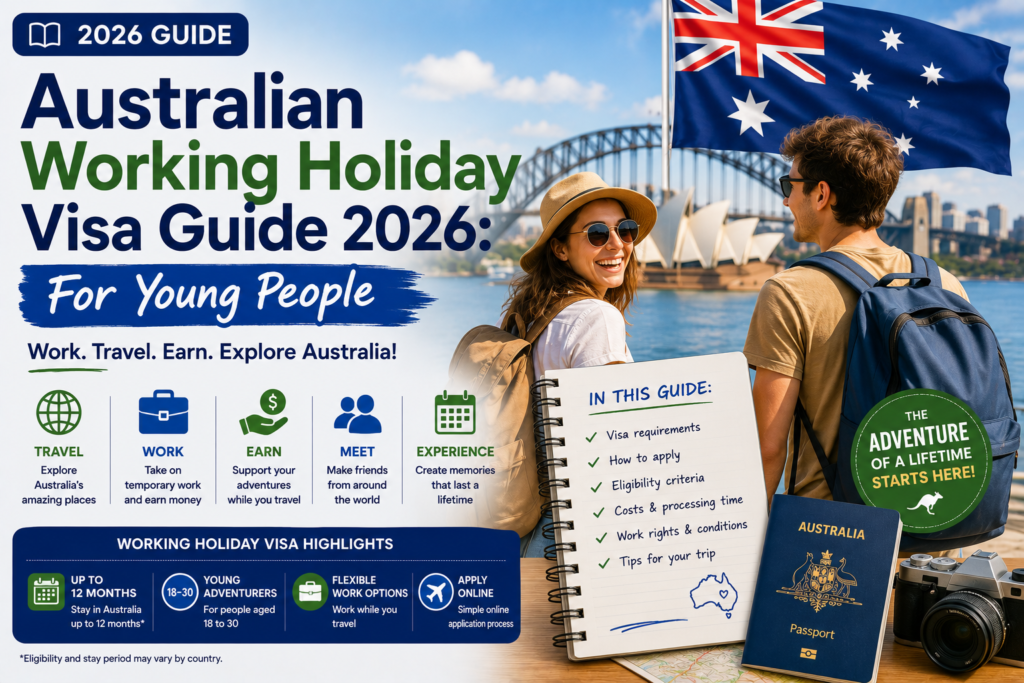
Australian Working Holiday Visa Guide 2026: Everything Young People Need to Know
Australia is globally renowned as the ultimate destination for young backpackers, gap-year students, and adventurous travelers. With its stunning coastlines, vibrant cities, and unique outback experiences, it offers an unparalleled lifestyle. But traveling across a country as massive and expensive as Australia requires significant funding. This is where the Australian Working Holiday Visa program steps in.
The Working Holiday Maker program allows young people from dozens of eligible countries to enter Australia for an extended holiday while legally taking on short-term employment to fund their travels. It is an extraordinary cultural exchange program that gives you the freedom to pick fruit in Queensland, pour coffees in Melbourne, or work at a ski resort in the Snowy Mountains, all within a single year.
However, securing this visa is not a casual process. The Department of Home Affairs enforces strict eligibility criteria regarding age, nationality, financial capacity, and health. Furthermore, if you dream of extending your stay for a second or third year, you must navigate the notorious “specified regional work” rules—often colloquially known as doing your “88 days of farm work.”
In this comprehensive Working Holiday Visa Guide, we will break down the crucial differences between the Subclass 417 and Subclass 462 visas, detail the exact documents you need to prove your financial standing, explain the step-by-step application process via ImmiAccount, and provide vital tips on how to set up your life in Australia (including securing your Tax File Number) the moment you land.
Key Takeaways
- Two Visa Types: The Working Holiday Visa (Subclass 417) and the Work and Holiday Visa (Subclass 462). Which one you apply for is entirely dictated by the passport you hold.
- Age Limits: Generally, you must be aged 18 to 30 inclusive. However, for citizens of certain countries (such as the UK, Canada, France, Italy, and Ireland), the age limit has been extended to 35.
- Financial Proof: You cannot arrive empty-handed. You must prove you have sufficient funds to support yourself initially (typically AUD $5,000) plus enough money to purchase a return flight home.
- Work Limitations: You can work to fund your holiday, but you generally cannot work for the same employer for more than 6 months without special permission.
- Extensions: You can extend your visa for a second and third year, provided you complete a set amount of “specified regional work” (such as agriculture, mining, or tourism in remote areas) during your first year.
What is the Working Holiday Visa? (417 vs 462)
When young people talk about backpacking in Australia, they are referring to the Working Holiday Maker program. However, from a legal standpoint, the Australian Government actually offers two distinct visas under this umbrella. If you are unsure which applies to you, checking our Visa Type Finder is a great first step.
The visa you must apply for is determined entirely by the passport you hold. You do not get to choose.
Working Holiday Visa (Subclass 417)
This is the traditional working holiday visa. It is available to passport holders from specific countries that have reciprocal agreements with Australia, primarily in Europe and parts of Asia (e.g., the United Kingdom, Canada, France, Germany, Ireland, Italy, Japan, South Korea).
Work and Holiday Visa (Subclass 462)
This is a newer iteration of the visa, designed for countries that do not qualify for the 417. It includes nations like the United States of America, Spain, China, Indonesia, Chile, and Argentina. The 462 visa often has slightly stricter eligibility requirements than the 417; for instance, applicants from certain countries may need to prove they hold a tertiary educational qualification or demonstrate functional English language skills. Furthermore, the 462 program often has a “cap” (a maximum quota of visas issued per year per country), whereas the 417 generally does not.
Who is Eligible? Age and Passport Rules
Before you start planning your road trip up the East Coast, you must ensure you meet the strict, non-negotiable eligibility criteria set by the Department of Home Affairs.
- Nationality: You must hold a valid passport from an eligible country.
- Age Requirements: You must be 18 to 30 years old (inclusive) at the time you apply. This means you can apply on the day before your 31st birthday. Once the visa is granted, you can enter Australia even if you have turned 31.
- Exception: For passport holders of Canada, France, Ireland, Italy, and the United Kingdom, the maximum age limit is 35 (meaning you can apply up until the day before your 36th birthday).
- No Dependent Children: You cannot be accompanied by dependent children at any time during your stay in Australia on this visa. If you have children, this is not the right visa for you.
- Financial Capacity: You must have sufficient funds to support yourself when you arrive in Australia. The standard benchmark is AUD $5,000. You must also have the funds to purchase a return or onward flight out of Australia at the end of your stay (or already possess a return ticket).
- Health and Character: You must meet the health requirements (which may involve a medical examination, depending on where you have traveled recently) and the character requirements (you may need to provide police certificates proving you do not have a substantial criminal record).
How It Works: Work and Study Limitations
The Working Holiday Visa offers immense freedom, but it is fundamentally a holiday visa, not a permanent work visa. The government places specific restrictions on your activities to ensure the primary purpose of your visit remains tourism and cultural exchange.
The 6-Month Work Limitation
The most important rule to understand is the six-month limitation. You can do any kind of work—from bartending to software engineering—but you generally cannot work for the same employer for more than 6 months. Once you hit the 6-month mark with a company, you must quit and find a new job.
Exceptions to the rule: The Department of Home Affairs occasionally relaxes this rule in specific industries. For example, during disaster recovery efforts, or in critical sectors like agriculture and healthcare in certain regional areas, you may be permitted to stay with one employer for up to 12 months. Always check the current policy before assuming you can stay.
The 4-Month Study Limitation
You are allowed to study in Australia on a Working Holiday Visa, but only for a maximum of 4 months (17 weeks). This is perfect for taking a short language course, a scuba diving certification, or a brief vocational certificate. If your primary goal is to complete a multi-year university degree in Australia, you must apply for a Student Visa instead. You can review the requirements for that pathway via our Student Visa Checklist.
Benefits: Why Choose This Visa?
The Working Holiday Visa is arguably the most flexible and empowering visa available to young people globally. The benefits include:
- Unrestricted Travel: You can enter and exit Australia as many times as you want during the 12-month validity of the visa.
- Fund Your Own Adventure: Unlike the standard Tourist Visa (which strictly prohibits all paid employment), this visa allows you to earn Australian dollars, which boast one of the highest minimum wages in the world, to fund expensive activities like Great Barrier Reef tours or Outback safaris. If you just want to visit without working, look into our Tourist Visa Checklist instead.
- Skill Development: It offers the chance to gain international work experience, whether you are developing soft skills in hospitality or practicing your profession in a corporate office in Sydney.
- Cultural Integration: Living and working alongside Australians provides a deeper, more authentic cultural experience than simply staying in tourist hotels.
Documents Required for a Fast Application
Applying online is a streamlined process, provided you have all your digital documents prepared in advance. Having perfectly scanned, clear documents prevents your application from stalling.
- Your Passport: A high-quality color scan of the bio-data page of your valid passport. Ensure it is valid for the entire duration of your planned stay.
- Proof of Funds: A recent bank statement (usually within the last 28 days) in your name, showing a balance equivalent to at least AUD $5,000, plus funds for a flight home.
- Identity Documents: A birth certificate displaying both parents’ names, or a national identity card.
- Educational/English Proof (462 Only): If you are applying for a Subclass 462 visa, you may need to upload copies of your university degree or results from an approved English language test (like IELTS or PTE), depending on your passport country.
- Character Documents: Police clearance certificates from any country where you have lived for more than 12 months in the last 10 years (if requested).
Step-by-Step Process: How to Apply
The entire application process is managed digitally through the Department of Home Affairs portal.
- Create an ImmiAccount: This is your official portal for all Australian visa interactions. You will use it to submit your application, pay fees, and upload documents.
- Start the Application: Select either the ‘Working Holiday Visa (417)’ or ‘Work and Holiday Visa (462)’ based on your passport. The online form will take about 30 to 45 minutes to complete. It will ask for your personal details, travel history, and health declarations.
- Upload Documents: Carefully attach the required PDFs or JPEGs of your passport and bank statements.
- Pay the Fee: The visa application charge (historically around AUD $635, though subject to change) must be paid via credit card or PayPal to submit the application.
- Complete Health Exams (If Required): After submitting, check your ImmiAccount. If you have spent time in countries with high rates of tuberculosis, or if you plan to work in a hospital or childcare center in Australia, you will be issued a “HAP ID.” You must take this ID to an approved panel physician in your home country to complete a medical exam and chest X-ray.
- Wait for the Grant Letter: Do not book non-refundable flights until you receive your official Visa Grant Notice in your email.
Extending Your Stay: Second and Third Year Visas
One year in Australia is rarely enough. The government allows Working Holiday Makers to apply for a Second-Year Visa, and subsequently a Third-Year Visa. However, to earn these extensions, you must roll up your sleeves and complete “Specified Regional Work”.
The 88 Days (Second Year)
To qualify for a second-year visa, you must complete 3 months (commonly referred to as 88 days) of specified work while holding your first working holiday visa. This work must be undertaken in specific regional areas of Australia.
Eligible industries typically include:
- Plant and animal cultivation (e.g., fruit picking, packing, farm hand work).
- Fishing and pearling.
- Tree farming and felling.
- Mining and construction (in specific regional postcodes).
- Tourism and hospitality (Note: This is usually restricted to Northern or very remote Australia).
The 6 Months (Third Year)
To qualify for a third-year visa, you must complete 6 months of specified regional work while holding your second working holiday visa.
Warning: You must keep meticulous records. Retain every single payslip, your employer’s ABN, and bank statements showing your wages being deposited. The Department of Home Affairs audits these applications heavily. Cash-in-hand farm work without payslips will not count towards your 88 days.
Getting Set Up in Australia (TFN, Medicare, Super)
The moment you step off the plane, you need to set up the administrative foundation of your new life to ensure you can work legally and safely.
- Apply for a Tax File Number (TFN): You cannot work in Australia without a TFN. If you do, your employer will be legally forced to tax you at the maximum emergency rate (almost 50%). You can only apply for a TFN online after you have physically entered Australia. To understand the timelines, read our TFN Processing Time guide.
- Open an Australian Bank Account: Most major Australian banks allow you to open an account online up to a few weeks before you arrive, but you will need to visit a branch with your passport upon arrival to verify your identity and collect your debit card.
- Healthcare: Australia has reciprocal healthcare agreements with several countries (like the UK, Italy, and New Zealand). If eligible, you must visit a Medicare office to get your card. If your country does not have an agreement, you are strongly advised to purchase comprehensive Overseas Visitors Health Cover (OVHC) from a private insurer.
- Superannuation: In Australia, employers must pay a percentage of your wages into a retirement fund (Superannuation). You should open a Super account with a major provider when you arrive. When you leave Australia permanently, you can claim this money back (minus taxes) via the Departing Australia Superannuation Payment (DASP).
Processing Times
If you are eager to depart, understanding Visa Processing Times is vital.
For the Working Holiday Visa (417), processing is notoriously fast. If you have no health issues and upload perfect documents, your visa can be granted in less than 24 hours. The average processing time is between 1 and 14 days.
For the Work and Holiday Visa (462), processing can take slightly longer due to the extra educational and English checks. Expect a wait of between 14 to 45 days. If you are required to undertake a medical examination, the processing clock stops until the clinic uploads your results to the Department.
Common Mistakes and Application Delays
- Applying Inside Australia Incorrectly: Your first Working Holiday Visa must be applied for while you are outside of Australia. If you apply while sitting in a Sydney hotel room on a tourist visa, your application will be refused. (Note: Second and third-year extensions can be applied for onshore).
- Insufficient Funds Proof: Uploading a screenshot of an app balance without your name on it will cause delays. You need a formal PDF bank statement featuring your full legal name.
- Ignoring Emails from ImmiAccount: If the Department requires further information (like a police check), they will send an email. If you miss it and fail to provide the document within 28 days, your visa will be refused and you will not get a refund.
Frequently Asked Questions
How much tax do backpackers pay in Australia?
Working Holiday Makers are subject to the “Backpacker Tax.” You will pay a flat tax rate of 15% on every dollar you earn up to $45,000 (as of current tax brackets). You do not get the tax-free threshold that Australian residents receive. Ensure you provide your TFN to your employer to avoid being taxed at a higher rate.
Can I work for myself or be an independent contractor?
Yes. You can apply for an Australian Business Number (ABN) and work as an independent contractor or sole trader (e.g., freelance writing, food delivery). However, the six-month work limitation still applies if you are contracting your services to a single business for an extended period.
What happens if my visa expires while I am in Australia?
You must not let your visa expire. If you overstay, you become an unlawful non-citizen, facing deportation and a potential 3-year ban from re-entering Australia. You must either apply for an extension, apply for a different visa (like a Student or Partner visa), or leave the country before the expiry date.
Do volunteer hours count towards my 88 days of farm work?
Generally, no. Since 2015, the Department of Home Affairs requires that specified regional work be paid in accordance with the relevant Australian award wage. Unpaid volunteer work (such as WWOOFing) typically no longer counts toward your 88 days for a visa extension.
Official Resources
For the most current eligibility rules, eligible passport lists, and application portals, always refer directly to the government:
- Home Affairs – Subclass 417 Visa
- Home Affairs – Subclass 462 Visa
- Australian Taxation Office – Working Holiday Makers
Conclusion
The Australian Working Holiday Visa is the golden ticket to one of the most defining experiences of your youth. It provides the perfect balance of adventure and financial sustainability, allowing you to traverse the vast Australian landscape while funding your journey through local employment.
However, successfully executing a gap year in Australia requires meticulous planning. You must select the correct visa subclass for your passport, ensure you have robust proof of funds, and respect the rigid limitations surrounding how long you can work for a single employer. If you intend to stay beyond your initial twelve months, you must tackle your specified regional work early, keeping flawless records of your payslips to satisfy the Department of Home Affairs.
By understanding the bureaucratic requirements upfront—from managing your ImmiAccount application to applying for your Tax File Number upon arrival—you can minimize stress and maximize the time spent enjoying the unparalleled freedom of an Australian working holiday.
Disclaimer
PublicServicesDesk.com is an independent informational website and is not affiliated with, endorsed by, or operated by the Australian Government, Services Australia, Centrelink, Medicare, MyGov, the Australian Taxation Office (ATO), or the Department of Home Affairs. Information is provided for general educational purposes only and may change over time. Always verify important details through official Australian Government websites before making decisions or submitting applications.