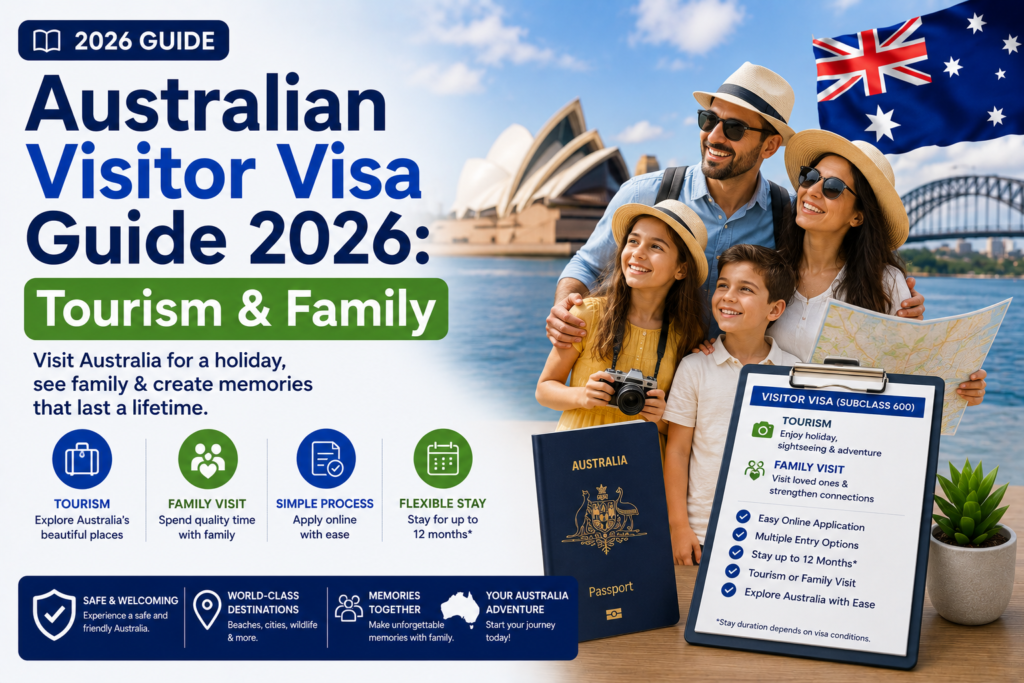
Australian Visitor Visa Guide 2026: Tourism, Family & Friends
Australia is a vast, breathtaking country that draws millions of international travelers every year. Whether your dream is to snorkel the Great Barrier Reef, drive the Great Ocean Road, or finally meet your newborn niece in Melbourne, your journey begins with a single, crucial step: securing the right visa.
For the vast majority of global travelers, the gateway to Australia is the Australian Visitor Visa (Subclass 600). This specific visa is designed strictly for short-term stays relating to tourism, visiting family and friends, or undertaking short-term non-working business activities.
However, many applicants underestimate the complexity of this process. The Department of Home Affairs does not hand out Visitor Visas automatically. They must be entirely convinced that you are a “Genuine Temporary Entrant.” If they suspect you intend to work illegally in Australia, or overstay your visa, your application will be swiftly refused. The burden of proof rests entirely on your shoulders to demonstrate strong ties to your home country, sufficient financial backing, and a legitimate itinerary.
In this exhaustive 2026 guide, we will break down the intricacies of the Visitor Visa. We will differentiate the Subclass 600 from electronic travel authorities, explain exactly what documents you need to prove your “genuine visitor” status, outline the rigorous application process via ImmiAccount, and discuss the specific requirements for the Sponsored Family stream.
Key Takeaways
- Strict ‘No Work’ Condition: The Visitor Visa strictly prohibits any form of paid employment in Australia. If you want to work, you must look into other options like the Working Holiday Visa.
- Genuine Visitor Requirement: You must convince the Australian government that you genuinely intend to return home. You do this by providing proof of employment, property ownership, or family commitments in your home country.
- Proof of Funds: You cannot arrive empty-handed. You must provide bank statements proving you have enough money to cover your flights, accommodation, and daily living expenses for the entirety of your stay.
- Length of Stay: Depending on your circumstances and passport, a Visitor Visa can be granted for stays of 3, 6, or 12 months. It can also be granted as a single entry or multiple entry visa.
- Sponsored Family Stream: If you are visiting close relatives who are Australian citizens or permanent residents, they can formally sponsor your visa, though they may be asked to pay a security bond.
What is the Australian Visitor Visa? (600 vs ETA/eVisitor)
Before beginning a lengthy application, it is vital to know if you even need a Subclass 600 Visitor Visa. Australia offers streamlined, electronic visas for citizens of certain “low-risk” countries. You can use our Visa Type Finder to see which one applies to your passport.
1. Electronic Travel Authority (ETA – Subclass 601) & eVisitor (Subclass 651)
If you hold a passport from an eligible country (such as the USA, UK, Canada, Japan, or most European nations), you generally do not need to apply for the complex Subclass 600. Instead, you can apply for an ETA or eVisitor visa. These are processed electronically, often within minutes, and allow you to visit Australia for up to 3 months at a time over a 12-month period.
2. Visitor Visa (Subclass 600)
You must apply for the comprehensive Subclass 600 Visitor Visa if:
- Your passport country is not eligible for an ETA or eVisitor visa (this applies to many countries in South America, Asia, Africa, and the Middle East).
- You want to stay in Australia for longer than 3 months (up to 6 or 12 months).
- You have complex health or character (criminal) issues that prevent an ETA approval.
- You are currently inside Australia on another temporary visa and wish to extend your stay as a tourist.
Who is Eligible? The Genuine Visitor Test
The Department of Home Affairs is highly vigilant against individuals using the Visitor Visa as a backdoor to illegally immigrate or work in Australia. Therefore, the core of the eligibility criteria revolves around the Genuine Temporary Entrant (GTE) requirement.
To be eligible, you must prove:
- Intent: You genuinely intend to visit Australia temporarily for tourism or to visit family/friends.
- Funds: You have adequate personal funds to support yourself during your stay without needing to work or rely on Australian public funds.
- Ties to Home: You have compelling reasons to return to your home country before your visa expires. This is the most heavily scrutinized aspect of the application.
- Health and Character: You meet Australia’s strict health and character requirements. You must declare all criminal convictions, no matter how minor or how long ago they occurred.
How It Works: Visa Conditions and Rules
If your Visitor Visa is approved, it will be attached to several strict conditions. Breaching any of these conditions can result in your visa being cancelled at the airport or during your stay, leading to immediate deportation and a potential 3-year ban from returning.
- Condition 8101 (No Work): You must not engage in any work in Australia. This includes paid employment, cash-in-hand jobs, and even unpaid work if it is work that would otherwise be done by an Australian resident for wages. (Volunteering for a registered charity is sometimes acceptable, but strictly regulated).
- Condition 8201 (Maximum 3 Months Study): You can undertake a short recreational course (like a 4-week English class or a scuba diving certificate), but you must not study or train in Australia for more than 3 months. If you wish to study full-time, see our Student Visa Checklist.
- Condition 8503 (No Further Stay): This condition is frequently attached to Visitor Visas. It means that while you are in Australia, you cannot apply for any other visa (such as a Partner Visa or Student Visa). You must leave Australia before you can apply for a new visa.
Sponsoring Family Members (Sponsored Family Stream)
If your relatives from a high-risk country have previously had tourist visas refused, the Sponsored Family Stream of the Subclass 600 visa is often the safest pathway.
In this stream, the applicant must have an eligible sponsor in Australia. The sponsor must be an Australian citizen or permanent resident, and they must be a close family member (parent, child, sibling, grandparent, grandchild, aunt, uncle, niece, or nephew). Fiancés and in-laws are generally excluded from being sponsors in this stream.
The Security Bond: Because the Australian relative is formally sponsoring the visitor, the Department of Home Affairs may request a security bond. This bond is typically between AUD $5,000 and $15,000 per person. The money is held by the government in trust. If the visitor complies with all visa conditions and leaves Australia before the visa expires, the bond is refunded in full to the sponsor. If the visitor overstays or works illegally, the bond is forfeited to the government.
Documents Required for a Strong Application
A poorly documented application is guaranteed to be refused. You must provide a comprehensive portfolio of evidence. We recommend utilizing our Tourist Visa Checklist to ensure nothing is missed.
Essential documents include:
- Identity: A high-quality scan of your passport bio-data page (it must be valid for at least 6 months), national ID cards, and a recent passport-sized photograph.
- Proof of Funds: The last 3 months of your personal bank statements showing consistent savings. Do not suddenly transfer a lump sum of money into your account the day before you apply; immigration officers look for consistent financial stability. You should also provide tax returns or audited business accounts if self-employed.
- Proof of Employment (Ties to Home): A formal letter from your employer granting you approved leave for the duration of your holiday, confirming your salary, your role, and stating that you are expected to return to work on a specific date.
- Proof of Assets (Ties to Home): Title deeds to your house, mortgage statements, or long-term vehicle leases in your home country. This proves you have financial reasons to return.
- Invitation Letter: If visiting family or friends, a detailed letter from them stating who they are, their address in Australia, their relationship to you, and whether they are providing free accommodation or financial support. They should include a copy of their Australian passport or PR grant notice.
- Travel Itinerary: A rough outline of your planned activities (e.g., booked hotel reservations, tour bookings). Note: The Department strongly advises against booking non-refundable flights before the visa is granted.
Step-by-Step Process: How to Apply
The Subclass 600 Visitor Visa application is entirely digital.
- Create an ImmiAccount: Navigate to the Department of Home Affairs website and create an ImmiAccount. This is the official portal for all applications.
- Start the Application: Select the ‘Visitor Visa (600)’ option. The form is extensive, often running to 20 pages of questions regarding your travel history, family members, and employment.
- Upload Documents: Attach all your meticulously gathered PDFs and JPEGs. Ensure files are clearly named (e.g., “John_Smith_Bank_Statements.pdf”).
- Pay the Fee: The visa application charge (historically starting from AUD $190, though subject to change) must be paid via credit card or PayPal.
- Provide Biometrics: For applicants from many countries in Asia, the Middle East, and Africa, you will receive an email shortly after applying requesting biometrics. You must visit an Australian Visa Application Centre (AVAC) in your home country to provide your fingerprints and a digital photograph. Your application will not be processed until this is done.
- Health Checks (If Required): If you plan to stay for 6 or 12 months, or if you are over 75 years of age, you may be asked to complete a medical examination with a panel physician.
- Wait for the Decision: Monitor your ImmiAccount and email inbox for the official Visa Grant Notice.
Processing Times
If you are planning to attend a specific event in Australia (like a wedding or a graduation), you must understand the Visa Processing Times to avoid heartbreak.
Processing times fluctuate drastically based on the time of year (it is much slower leading up to Christmas and the Australian summer) and the complexity of your application.
- Tourist Stream (Applied Outside Australia): Generally takes between 14 to 35 days.
- Sponsored Family Stream: Generally takes between 30 to 50 days (due to the extra checks required for the sponsor and the arrangement of the security bond).
- Tourist Stream (Applied Inside Australia): If you are extending a current visa onshore, processing can take 10 to 20 days. You will be granted a Bridging Visa to keep you lawful while you wait.
Common Mistakes and Refusal Reasons
A visa refusal leaves a permanent black mark on your immigration record, making future applications to Australia (and other countries like the USA and UK) much more difficult. Avoid these critical errors:
- Lack of Employment Ties: If you are unemployed, single, and do not own property in your home country, the Department will view you as a massive “flight risk” (someone likely to overstay). You must provide overwhelming evidence of other ties, such as caring responsibilities for elderly parents or upcoming university enrollments.
- Insufficient Funds: Applying for a 3-month holiday but only showing a bank balance of $1,000. Australia is expensive; the Department calculates roughly $1,000 to $1,500 per month of your stay, plus flight costs.
- Generic Invitation Letters: Having an Australian friend write “John is coming to stay with me” is not enough. The letter must detail the exact relationship, the address, and clearly state that the friend understands John cannot work in Australia.
- Applying for 12 Months Unnecessarily: Asking for a 12-month tourist visa triggers immense scrutiny. Very few people can afford a 12-month holiday without working. Unless you are a retired parent visiting a citizen child, requesting 12 months often leads to a swift refusal. Always request the exact time you need.
Tips for a Successful Application
- Write a Cover Letter: Do not just upload raw documents. Write a 1-page cover letter introducing yourself, explaining the purpose of your trip, summarizing your financial capacity, and explicitly stating your intention to return home to your job/family by a specific date. This humanizes your application.
- Translate Documents: Every document not in English (such as foreign bank statements or employment letters) must be accompanied by an official, certified translation.
- Apply Well in Advance: Do not apply two weeks before your intended flight. Apply at least two months in advance. If the Department requests further information (like a police check), it can delay the process by weeks.
If you are struggling with the digital uploads, review our Government Application Support Guide.
Frequently Asked Questions
Can I work on an Australian Visitor Visa?
No. Condition 8101 is strictly enforced on all Visitor Visas. You cannot undertake paid work, cash-in-hand jobs, or even unpaid work that an Australian resident would normally be paid for. If you wish to work, you must apply for a Working Holiday Visa or an Employer-Sponsored Visa.
Can my Australian friend sponsor my Visitor Visa?
A friend can provide a ‘Letter of Invitation’ and offer to provide free accommodation or financial support during your stay for the standard Tourist stream. However, a friend cannot formally sponsor you under the ‘Sponsored Family Stream’—that stream is strictly reserved for close blood relatives or spouses.
Can I extend my Visitor Visa once I am in Australia?
You can only apply to extend your stay (by applying for a new onshore Visitor Visa) if your current visa does not have ‘Condition 8503 – No Further Stay’ attached to it. If it has Condition 8503, you must leave Australia before it expires, unless you can prove extreme, unforeseeable compassionate circumstances to have the condition waived.
Do I need health insurance for a Visitor Visa?
While it is not always a mandatory visa condition for tourists, the Australian Government strongly recommends purchasing comprehensive travel or health insurance. Australian healthcare is incredibly expensive for non-residents, and you will not have access to Medicare (unless your country has a reciprocal agreement).
Official Resources
For the most current application fees, biometric requirements, and direct portal access, always refer directly to the government:
Conclusion
The Australian Visitor Visa is your essential key to experiencing the wonders of Australia, from exploring its pristine environments as a tourist to sharing invaluable moments with family and friends. While the allure of the destination is strong, the application process demands serious respect and meticulous preparation.
The Department of Home Affairs is tasked with protecting Australia’s borders, and they require undeniable proof that you are a genuine visitor. By assembling a robust portfolio of evidence—highlighting your secure employment back home, your substantial financial savings, and a clear, logical travel itinerary—you drastically minimize the risk of a devastating visa refusal.
Whether you are applying independently through the standard tourist stream or utilizing the Sponsored Family stream to reunite with loved ones, starting your application early and ensuring every document is perfectly presented in your ImmiAccount is the best strategy for a stress-free journey down under.
Disclaimer
PublicServicesDesk.com is an independent informational website and is not affiliated with, endorsed by, or operated by the Australian Government, Services Australia, Centrelink, Medicare, MyGov, the Australian Taxation Office (ATO), or the Department of Home Affairs. Information is provided for general educational purposes only and may change over time. Always verify important details through official Australian Government websites before making decisions or submitting applications.