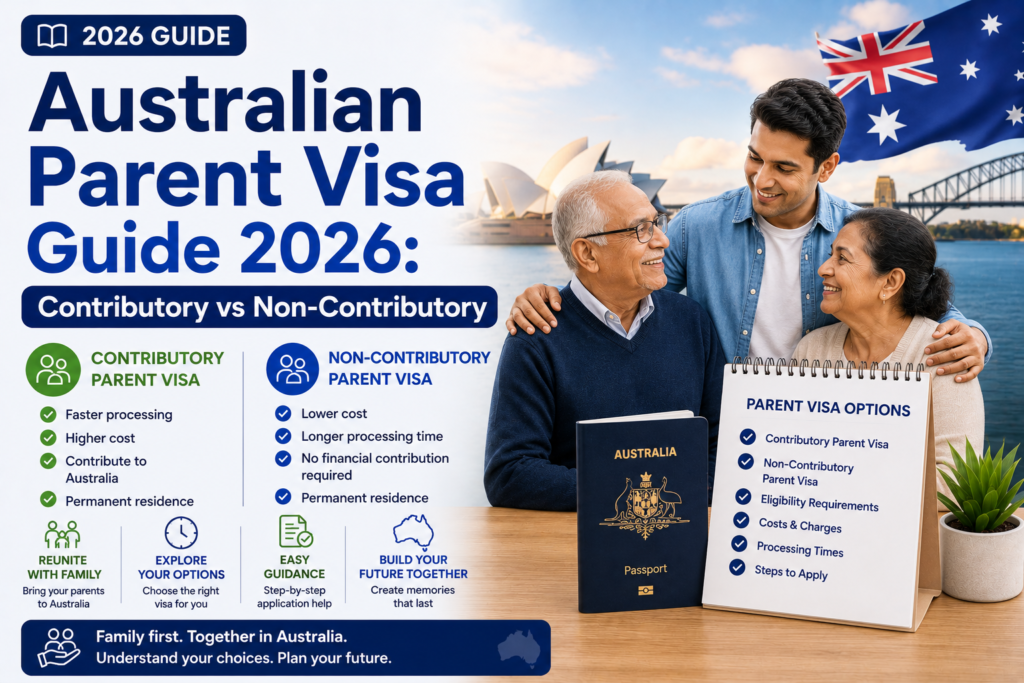
Australian Parent Visa Guide 2026: Family Visas for Parents Explained
For many migrants who have successfully settled in Australia, achieving permanent residency or citizenship is only half the dream. The ultimate goal is to bring their parents over from their home country so the family can be permanently reunited. Having grandparents around to watch the kids grow up in the safety and prosperity of Australia is a universal desire.
However, the Australian Parent Visa system is arguably the most complex, expensive, and frustrating immigration pathway managed by the Department of Home Affairs. Unlike skilled migration, which Australia actively encourages to boost the economy, the government views elderly parent migration as a massive net drain on the public purse—specifically concerning future healthcare and aged care costs.
To offset these costs, the government has implemented extreme measures. If you want your parents to live in Australia permanently, you must either pay an exorbitant fee (often exceeding AUD $50,000 per parent) for a “Contributory” visa, or you must place them in a “Non-Contributory” queue where the official estimated wait time spans decades. Furthermore, your parents cannot even apply unless they pass the mathematical hurdle known as the Balance of Family Test.
In this comprehensive 2026 guide, we will break down the harsh realities of the Family Visa for parents. We will meticulously explain the difference between the Contributory and Non-Contributory streams, outline the financial burden of the Assurance of Support, discuss the temporary Subclass 870 alternative, and guide you through the intricate steps required to lodge a valid application.
Key Takeaways
- Balance of Family Test: This is a non-negotiable legal requirement. At least half of your parents’ children must be permanently living in Australia for the parents to be eligible for a permanent visa.
- The Wealth Divide: “Contributory” visas (Subclass 143) cost roughly $50,000 per parent but are processed in roughly 5 to 12 years. “Non-Contributory” visas (Subclass 103) cost only a few thousand dollars but currently have an estimated wait time of 30 to 50 years.
- Assurance of Support (AoS): As the sponsor, you (or another Australian resident) must lodge a massive cash bond with Centrelink to guarantee your parents will not claim Australian welfare payments for up to 10 years after arrival.
- The Temporary Alternative: If permanent residency is too expensive or slow, the Sponsored Parent (Temporary) visa (Subclass 870) allows parents to stay for 3 or 5 years without passing the Balance of Family Test, though they receive no Medicare.
- Onshore vs Offshore: “Aged” parents (those over the Australian pension age) may be able to apply while physically inside Australia and receive a Bridging Visa to stay during the long processing wait.
What is the Australian Parent Visa?
The Australian Parent Visa program is a suite of visa subclasses designed to allow the parents of Australian citizens, permanent residents, or eligible New Zealand citizens to migrate to Australia.
If you are confused by the dozens of visa subclasses, you can start by exploring our Visa Type Finder. For parents, the pathways are divided across three main fault lines:
- Permanent vs Temporary: Do they want to migrate forever and eventually become citizens, or just visit for a few years?
- Contributory vs Non-Contributory: Are you willing to pay the government ~$50,000 per parent to fast-track the processing, or do you want the cheap option that takes decades?
- Aged vs Non-Aged (Onshore vs Offshore): If your parent has reached the Australian age pension age (currently 67 years old), they are considered “Aged.” Aged parents generally have the privilege of applying while physically sitting inside Australia and riding out the processing time on a Bridging Visa. Non-aged parents must usually apply from overseas and wait overseas.
The Golden Rule: The Balance of Family Test
Before you calculate costs or processing times, you must pass the Balance of Family (BoF) Test. If your parents fail this mathematical test, they cannot apply for any permanent parent visa (though they can still apply for the temporary Subclass 870).
The test measures the parent’s ties to Australia. To pass, at least half of the parent’s total children must live permanently in Australia, OR more children must live permanently in Australia than in any other single country.
Examples:
- Your parents have 2 children. You live in Sydney as a PR. Your brother lives in London. The test is passed (50% live in Australia).
- Your parents have 3 children. You live in Melbourne as a citizen. Your two sisters live in India. The test is FAILED (only 33% live in Australia). Your parents cannot get a permanent visa.
- Your parents have 3 children. You live in Perth as a PR. Sister A lives in Canada. Sister B lives in Japan. The test is passed (No other single country has MORE children than Australia).
The Department counts all children, including stepchildren and adopted children, regardless of whether those children are dependent or independent.
Who is Eligible to Sponsor?
To sponsor your parents, you must meet the following criteria:
- Age: You must be 18 years of age or older.
- Status: You must be an Australian citizen, an Australian permanent resident, or an eligible New Zealand citizen.
- Settled Requirement: The Department requires you to be “settled” in Australia. Generally, this means you must have been lawfully living in Australia for at least two years before you lodge the sponsorship application. If you just got your PR grant yesterday, you usually cannot sponsor your parents today.
Contributory vs Non-Contributory Visas
This is the most critical decision a family will make. The Australian Government explicitly caps the number of Parent Visas it issues each year (often limiting it to around 8,500 places total across the globe). Because demand vastly exceeds supply, a massive backlog exists.
Contributory Parent Visas (Subclass 143 & 864 Aged)
The government created the “Contributory” stream for families willing to make a substantial financial contribution to offset the future healthcare costs of the parents.
- The Cost: The base application fee is a few thousand dollars. However, right before the visa is granted, the Department issues a “Second Installment” invoice. Currently, this sits at $43,600 AUD per parent. If both parents are migrating, you must pay nearly $90,000. This is non-refundable, even if the parent dies a month after arriving.
- The Wait: Even though you are paying a fortune, you still wait. Due to visa capping, Contributory applications currently take between 5 to 12 years to be processed from the date of lodgment.
- The Benefit: Full permanent residency. After the wait, they get unrestricted work rights, a pathway to citizenship, and full access to Medicare.
Non-Contributory Parent Visas (Subclass 103 & 804 Aged)
This is the standard queue.
- The Cost: It is relatively cheap, usually costing under $10,000 total per parent. There is no massive $43,600 second installment.
- The Wait: The Department of Home Affairs officially states that new applications in this stream may take up to 30 to 50 years to be processed. For an elderly parent, this is effectively a polite refusal.
- The Loophole (Subclass 804): Why do people apply for this? Because of the “Aged” loophole. If a parent is over 67, they can enter Australia on a tourist visa, apply for the Subclass 804 onshore, and be granted a Bridging Visa A (BVA). This Bridging Visa allows them to live in Australia indefinitely while they wait 30 years in the queue. They will likely pass away in Australia before the visa is ever actually processed. The major downside? They receive absolutely no Medicare access during those decades on the Bridging Visa and must pay for all private health insurance themselves.
The Temporary Alternative (Subclass 870)
Introduced to alleviate the massive queues, the Sponsored Parent (Temporary) visa (Subclass 870) is an increasingly popular alternative.
- Balance of Family: You DO NOT need to pass the Balance of Family Test for this visa. Even if you are the only child in Australia out of 10 children, your parents can apply.
- Duration: It allows parents to stay in Australia for 3 years or 5 years continuously. They can renew it once, for a maximum cumulative stay of 10 years.
- Cost: Approx $5,735 for a 3-year visa, or $11,470 for a 5-year visa (per parent).
- Limitations: It does NOT lead to permanent residency. Parents cannot work in Australia. Parents get zero Medicare access and must hold comprehensive Overseas Visitors Health Cover (OVHC) for the entire 5 years.
- Processing: It is relatively fast, often processed within 4 to 8 months.
The Assurance of Support (AoS) Bond
For all permanent parent visas (Contributory and Non-Contributory), the government demands financial security to ensure the parents do not become a burden on the Australian taxpayer.
Before the visa is granted, you must secure an Assurance of Support (AoS) through Centrelink.
- You (the sponsor) must prove you have a sufficiently high taxable income (usually over $60,000 to $90,000 depending on family size).
- You must lodge a cash bond with the Commonwealth Bank. For a Contributory visa, the bond is $10,000 for the main applicant and $4,000 for the secondary applicant.
- The government locks this money away for 10 years (for Contributory visas).
- During those 10 years, if your parent claims any Centrelink welfare payments (like JobSeeker or the Age Pension), the government will deduct the money they paid your parent directly from your $14,000 bond. If the bond runs out, you personally owe the government a debt. The remaining bond is refunded to you after the 10 years expire.
Documents Required for the Application
The documentary evidence required is immense and focuses heavily on proving family lineage.
- Identity: Passports, national identity cards, and passport photos for the parents.
- Proof of Relationship: The most vital documents. You must provide official Birth Certificates proving you are the child of the applicants. If your name has changed (e.g., through marriage), you must provide the marriage certificate to link your current name back to the birth certificate.
- Balance of Family Evidence: You must declare every single child your parents have ever had. You must provide evidence of where every sibling lives (e.g., copies of their foreign passports, utility bills in foreign countries, or Australian PR grants).
- Sponsor Eligibility: Your Australian passport, citizenship certificate, or PR grant notice, plus evidence you are “settled” (e.g., 2 years of Australian tax returns, lease agreements, utility bills).
- Police Clearances: Parents must provide police checks from every country they have lived in for 12 months or more over the last 10 years.
- Health Exams: Parents must undergo rigorous medical exams by panel physicians. If an elderly parent has severe health issues (e.g., advanced dementia, kidney failure requiring dialysis), they will fail the health requirement and the visa will be refused, regardless of how much money you offer to pay.
Step-by-Step Process: How to Apply
- Assess the BoF Test: Calculate the Balance of Family Test. If they fail, pivot immediately to the Subclass 870 Temporary Visa.
- Prepare Finances: If applying for Contributory, ensure you realistically have the means to pay ~$100,000 (for two parents) when the invoice arrives in 5-10 years.
- Lodge the Application: Parent visas are slowly moving to digital lodgment via ImmiAccount, though some streams previously required mailing physical paper applications to the Parent Visa Centre in Perth. Always check the current Home Affairs instructions.
- The Waiting Game: Your parents will be placed in the global queue. You will wait years.
- AoS and Health Checks: Years later, a Case Officer will finally open your file. They will instruct you to undertake the medical exams and ask you to approach Centrelink to organize the Assurance of Support bond.
- The Final Invoice: Once the AoS and health checks clear, you will be issued the invoice for the massive Second Installment.
- Visa Grant: Once the money clears the government accounts, the Permanent Visas are granted!
For help navigating digital portals and Centrelink requirements, review our Government Application Support Guide.
Processing Times and the Queuing System
The Visa Processing Time for parents is dictated by the “Capping and Queuing” legislation.
The government sets a maximum cap on how many parent visas they will grant in a financial year. Because hundreds of thousands of people apply, the cap is reached instantly. Applications are placed in a queue in date order. You simply must wait until your place in the queue reaches the front of the line during a financial year where cap spaces are available.
Currently, the Department is finalizing Contributory applications lodged in 2017. If you apply today, realistic estimates suggest a wait of at least 8 to 12 years. You must factor this wait time into your parent’s aging and deteriorating health.
Frequently Asked Questions
Do parents on a Contributory Visa get Medicare?
Yes. Once the Permanent Contributory Visa (143/864) is granted, your parents become permanent residents and are fully eligible to enroll in Medicare for free public hospital care and subsidized doctor visits.
Can my parents work in Australia on a Parent Visa?
Yes. Permanent Parent Visas (Contributory and Non-Contributory) carry no work restrictions. Your parents can work full-time, part-time, or start a business in Australia.
Can I pay the $43,600 Contributory fee in installments?
No. When the Department issues the invoice for the Second Installment, you are generally given 28 days to pay the entire amount in a single lump sum. If you cannot produce the money, the visa application will be refused.
What happens if a parent dies while waiting in the queue?
If you applied for both parents and the primary applicant passes away during the decade-long wait, the surviving spouse can usually continue with the application. You must immediately notify the Department of Home Affairs and provide a death certificate.
Official Resources
Because costs and caps change every single financial year (July 1st), you must verify the latest figures directly with the government:
- Home Affairs – Subclass 143 Contributory Parent Visa
- Home Affairs – Subclass 870 Sponsored Parent (Temporary)
- Services Australia – Assurance of Support (AoS)
Conclusion
The Australian Parent Visa system forces families to make incredibly difficult decisions. Achieving the dream of family reunification requires navigating the strict mathematics of the Balance of Family Test, enduring decade-long processing queues, and committing to staggering financial costs through the Contributory stream and the Assurance of Support.
For those who can afford the ~$50,000 per parent fee, the Contributory Visa (143/864) remains the most viable pathway to secure permanent residency and Medicare access before parents become too frail to travel. For those priced out of the permanent market, the Subclass 870 Temporary Visa provides a crucial, albeit Medicare-free, alternative to keep the family together for up to a decade.
Given the massive financial risks—where a failed health check or a misunderstood Balance of Family calculation can result in thousands of dollars in lost application fees—meticulous preparation and absolute honesty in your documentation are your only defenses against a heartbreaking visa refusal.
Disclaimer
PublicServicesDesk.com is an independent informational website and is not affiliated with, endorsed by, or operated by the Australian Government, Services Australia, Centrelink, Medicare, MyGov, the Australian Taxation Office (ATO), or the Department of Home Affairs. Information is provided for general educational purposes only and may change over time. Always verify important details through official Australian Government websites before making decisions or submitting applications.