Australian Permanent Residency Guide 2026: How to Live and Work Permanently
Australia consistently ranks as one of the most desirable countries in the world to live. With its robust economy, world-class healthcare system, unparalleled natural beauty, and highly coveted work-life balance, it is little wonder that millions of people dream of making it their forever home. The ultimate goal for these individuals is securing Australian Permanent Residency (PR).
A Permanent Residency visa is the golden ticket. It transforms you from a temporary visitor—subject to visa expiry dates, work restrictions, and international student fees—into a permanent member of the Australian community. As a PR holder, you gain the unrestricted right to live and work in Australia permanently, access the renowned Medicare system, buy property without foreign investment penalties, and, crucially, step onto the direct pathway to Australian Citizenship.
However, the journey to PR is complex, highly competitive, and famously bureaucratic. The Department of Home Affairs operates a myriad of visa streams, ranging from points-tested skilled migration and employer sponsorship, to family and partner visas. Choosing the wrong pathway, or failing a skills assessment, can cost you thousands of dollars and set your migration dream back by years.
In this definitive 2026 guide, we will demystify the entire Australian Permanent Residency process. We will break down the most popular PR pathways, explain exactly how the formidable SkillSelect points system works, outline the rigorous documents required, and provide actionable tips to avoid the common mistakes that cause application delays or outright refusals.
Key Takeaways
- Unrestricted Rights: PR grants you the right to work for any employer in any industry, study at domestic university fee rates, and live anywhere in Australia indefinitely.
- Three Main Pathways: The vast majority of PR visas are granted through Skilled Migration (points-based), Employer Sponsorship, or Family/Partner sponsorship.
- The Points System: For skilled migration, you must score a minimum of 65 points based on age, English proficiency, work experience, and education to even be considered.
- Patience is Required: PR is not instantaneous. Between skills assessments, Expression of Interest (EOI) waiting periods, and actual visa processing times, the journey often takes 12 to 24 months.
- Medicare Access: The moment you apply for most onshore PR visas, you immediately become eligible to enroll in Medicare, providing huge healthcare savings while you wait for the visa grant.
What is Australian Permanent Residency?
Australian Permanent Residency is a visa classification that allows a non-citizen to live, work, and study in Australia indefinitely. While you remain a citizen of your home country (and travel on your home country’s passport), your status within Australia is almost identical to that of an Australian citizen, with only a few minor exceptions.
Permanent Residents cannot vote in Australian federal or state elections, cannot hold an Australian passport, and cannot automatically join the Australian Defence Force. Additionally, while the right to live in Australia is permanent, the “travel facility” attached to a PR visa usually expires after five years. This means if you wish to leave and re-enter Australia as a PR holder after five years, you must apply for a Resident Return Visa (RRV), or, more commonly, simply apply for Australian Citizenship before the five years are up.
If you are confused about which PR visa might apply to your unique situation, we recommend starting with our Visa Type Finder tool.
Benefits: Why Pursue PR?
Transitioning from a temporary visa (like a Student or Working Holiday visa) to PR is a monumental milestone due to the sheer volume of benefits it unlocks:
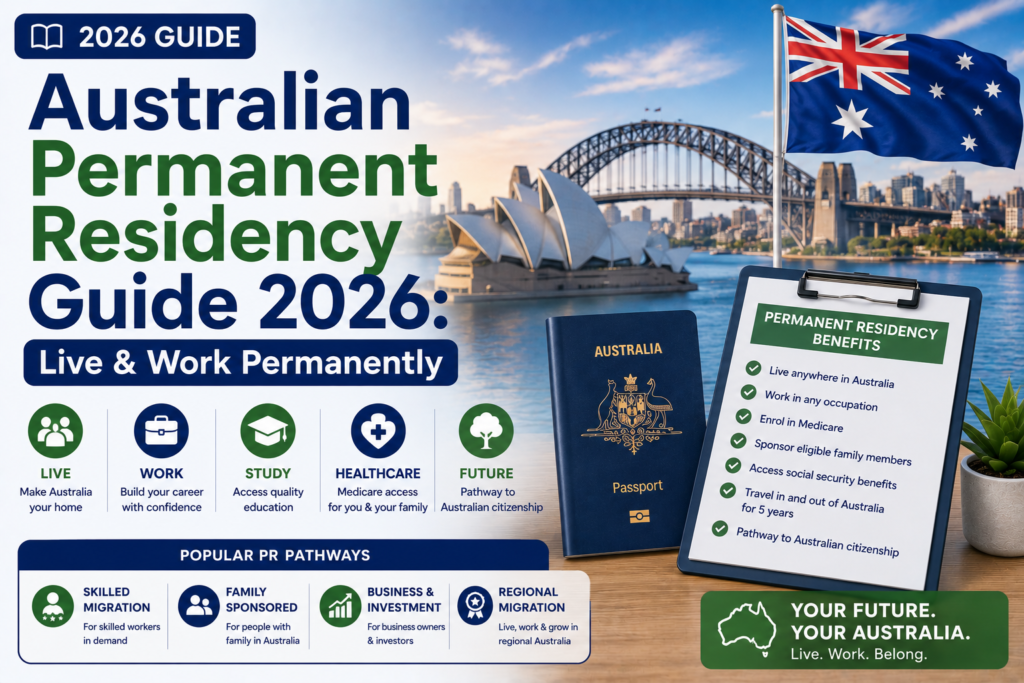
- Unlimited Work Rights: You can work in any industry, for any employer, for as many hours as you like. You are no longer bound by the restrictions of student visas or temporary employer sponsorships.
- Free Healthcare: You gain full access to Medicare, Australia’s public health system, providing free treatment in public hospitals and subsidized doctor visits.
- Domestic Study Fees: Instead of paying exorbitant international student fees, you pay domestic rates at Australian universities. Furthermore, you may become eligible for government student loans (HELP loans/HECS).
- Social Security: After waiting periods (usually up to 4 years), you can access Centrelink welfare payments, including unemployment benefits and family tax benefits.
- Property Ownership: You can buy established residential property in Australia without needing approval from the Foreign Investment Review Board (FIRB), and you avoid massive foreign buyer stamp duty surcharges.
- Sponsor Family: You gain the right to sponsor your spouse, de facto partner, or parents for their own permanent residency visas.
Who is Eligible? The Major PR Pathways
There is no single “Permanent Residency Visa.” Instead, there are dozens of different visa subclasses that grant permanent residency. They broadly fall into three categories: Skilled, Employer-Sponsored, and Family.
1. Skilled Migration (Points-Tested)
This is the most common pathway for independent professionals who do not have an employer sponsoring them. It relies on the applicant having a profession listed on the Medium and Long-term Strategic Skills List (MLTSSL) or the Short-term Skilled Occupation List (STSOL).
- Skilled Independent Visa (Subclass 189): The most prestigious skilled visa. It does not require state or employer sponsorship. You can live and work anywhere in Australia.
- Skilled Nominated Visa (Subclass 190): You must be nominated by an Australian State or Territory government. In return for the nomination (which gives you extra points), you must commit to living in that specific state for at least two years.
- Skilled Work Regional Visa (Subclass 491): While technically a 5-year provisional visa, it leads directly to the Permanent Residence (Skilled Regional) visa (Subclass 191) if you live and work in a designated regional area for three years.
2. Employer-Sponsored Visas
If you have an Australian employer who is willing to sponsor you permanently, this is an excellent pathway.
- Employer Nomination Scheme (Subclass 186): A direct permanent residency visa. You must have a willing employer, generally have 3 years of post-qualification work experience, and pass a skills assessment. Many people transition to this visa after holding a Temporary Skill Shortage (Subclass 482) visa.
3. Family and Partner Visas
If you have close family ties to Australia, you may be eligible without needing to pass a points test or skills assessment.
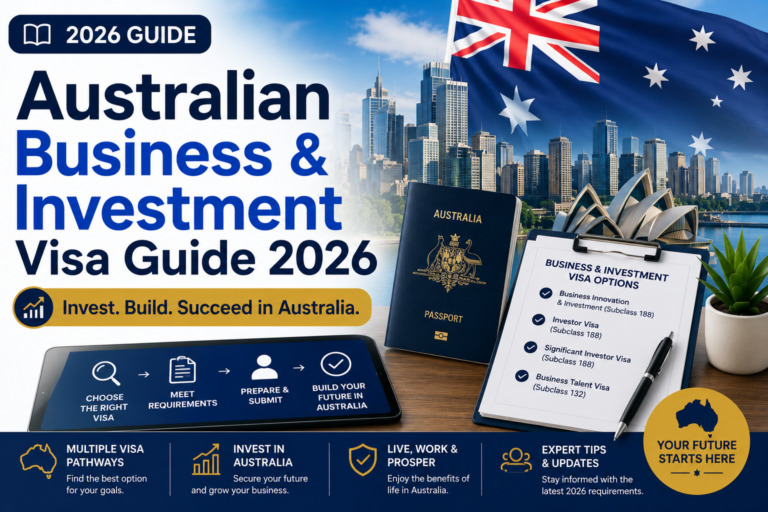
- Partner Visas (Subclass 820/801 or 309/100): For spouses or de facto partners of Australian citizens or PR holders. You apply for a temporary and permanent visa simultaneously; the permanent visa is usually granted two years after the initial application, provided the relationship is still genuine. See our Partner Visa Checklist for evidence requirements.
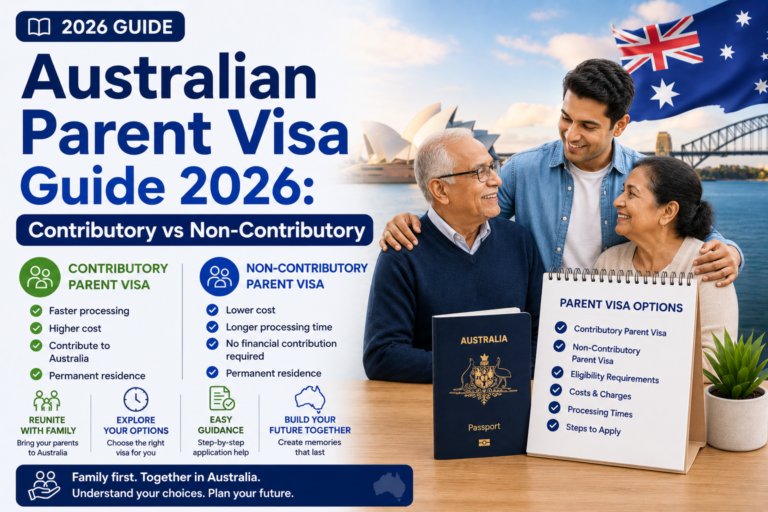
- Parent Visas: For parents of settled Australian citizens or PR holders. (Note: These visas are notoriously expensive or have wait times stretching into decades).
How It Works: The SkillSelect Points System
If you are applying for the 189, 190, or 491 visas, your entire fate rests on the SkillSelect Points Test. The Australian government uses this test to rank applicants against each other. You must score a minimum of 65 points to submit an Expression of Interest (EOI). However, because the system is competitive, scoring 65 points rarely guarantees an invitation; the highest-scoring applicants are invited first.
You can calculate your exact score using our Skilled Visa Points Estimator. Points are awarded based on:
- Age: You receive the maximum points (30) if you are aged between 25 and 32. Points decrease as you get older, and you cannot apply for skilled migration once you turn 45.
- English Proficiency: ‘Competent’ English (e.g., IELTS 6 in all bands) gets you 0 extra points but makes you eligible. ‘Proficient’ English (IELTS 7) gets you 10 points. ‘Superior’ English (IELTS 8) gets you 20 points. Maxing out your English score is the single best way to boost your PR chances.
- Skilled Employment: Points are awarded for years of relevant work experience in your nominated occupation, both within Australia and overseas.
- Educational Qualifications: A Doctorate gives you 20 points; a Bachelor or Masters degree gives you 15 points; a Trade Qualification/Diploma gives you 10 points.
- Australian Study Requirement: You get 5 extra points if you completed a degree, diploma, or trade qualification in Australia that took at least two academic years. For a breakdown of student pathways, see our Student Visa Checklist.
- State/Regional Nomination: Being nominated by a State for a 190 visa gives you 5 points. A regional nomination for a 491 visa gives you an enormous 15 points.
- Partner Skills: You get 10 points if you are single, or 10 points if your partner also passes a skills assessment and has competent English.
Documents Required for PR
A PR application requires a mountain of flawless documentation. One fraudulent or incorrect document can result in a 10-year ban from Australia.
- Skills Assessment: The most crucial document. Before you can even submit an EOI, a relevant Australian assessing authority (e.g., Engineers Australia, CPA Australia, Trades Recognition Australia) must assess your qualifications and work experience and declare that you are skilled in your nominated occupation.
- English Test Results: Valid results from an approved test (IELTS, PTE Academic, TOEFL iBT, Cambridge C1 Advanced). These are usually valid for 3 years.
- Identity Documents: Passport, birth certificate, and national identity cards.
- Work Experience Proof: Tax returns, payslips, superannuation records, and detailed reference letters from employers outlining your specific daily duties.
- Police Checks: You must provide a police clearance from every country you have lived in for 12 months or more over the past 10 years.
- Medical Examination: Once requested by the Department, you must undergo a rigorous health check by a panel physician to prove you do not carry a public health risk or a condition that would cost the Australian healthcare system a significant amount of money.
Step-by-Step Process: How to Apply (Skilled Migration)
The standard process for a points-tested skilled visa (189/190) operates as follows:
- Check Your Occupation: Ensure your profession is on the relevant skilled occupation list.
- Get Your Skills Assessed & Take the English Test: You must have both of these completed before step 3.
- Submit an Expression of Interest (EOI): Log into the government’s SkillSelect portal and create an EOI. This is not a visa application; it is simply telling the government you exist and what your points score is. It is free to submit an EOI.
- Wait for an Invitation to Apply (ITA): If you have a high points score, the federal government (for the 189) or a state government (for the 190) may send you an ITA. Invitation rounds occur periodically.
- Lodge the Visa Application: Once you receive an ITA, you have 60 days to officially lodge your visa application via ImmiAccount and pay the substantial application fee (often over AUD $4,500).
- Provide Biometrics and Health Checks: Wait for the Department to request these.
- Visa Grant: If approved, you will receive your Permanent Residency grant notice!
Common Mistakes and Delays
- Overclaiming Points: The most fatal error. If you claim 75 points in your EOI, receive an invite, but can only prove 70 points when you lodge the actual visa application with your documents, your visa will be refused and your money will not be refunded. Never claim points you cannot back up with hard evidence.
- Letting English Tests Expire: English tests are generally only valid for 3 years. If your test expires while you are sitting in the EOI pool waiting for an invite, your EOI becomes invalid.
- Inconsistent Employment References: If your employer reference letter just says “John was a good worker” without detailing the specific tasks you performed, the assessing authority will reject your work experience. It must match the strict duties outlined in the ANZSCO dictionary.
Processing Times
The timeline for securing PR tests the patience of even the most resilient applicants. You can review current trends at our Visa Processing Time hub.
For skilled visas (189/190), you might wait 6 to 12 months in the EOI pool just to receive an invitation. Once the actual visa application is lodged, processing typically takes between 6 to 12 months, depending on how quickly the Department processes health and character checks.
For Partner Visas (820/801), the process is notoriously slow. The temporary stage can take 12 to 24 months, and the permanent stage takes an additional year or more. However, as soon as you lodge the onshore application, you receive a Bridging Visa that allows you to remain in Australia, work, and access Medicare.
Frequently Asked Questions
Can my Australian Permanent Residency be cancelled?
Yes. While it is permanent, it is not absolute. If you are convicted of a serious crime and sentenced to more than 12 months in prison, you fail the ‘Character Test’ under Section 501 of the Migration Act, and your PR can be cancelled resulting in deportation. You are only completely safe from deportation once you become an Australian Citizen.
When can I apply for Australian Citizenship?
To be eligible for citizenship by conferral, you must have lived in Australia on any valid visa for the past 4 years, and you must have held Permanent Residency for at least the last 12 months immediately before applying. You must not have been out of Australia for more than 12 months in total in the past 4 years.
Do I have to live in a regional area?
Only if you apply for a regional visa, such as the Subclass 491 or a regionally-sponsored 190. If you receive a Subclass 189 Skilled Independent visa, or an Employer Sponsored 186 visa (non-regional), you can live in Sydney, Melbourne, Brisbane, or anywhere else you choose from day one.
Does my PR expire if I leave Australia?
Your right to live in Australia never expires. However, the ‘travel facility’ on your PR visa expires 5 years after it is granted. If you leave Australia after 5 years, you will need to apply for a Resident Return Visa (RRV) to get back in. To avoid this, most people apply for citizenship as soon as they are eligible.
Official Resources
For the most current occupation lists, points tables, and application portals, always refer directly to the government:
- Home Affairs – SkillSelect Portal
- Home Affairs – Subclass 189 Visa
- Services Australia – Enrolling in Medicare
Conclusion
Achieving Australian Permanent Residency is a life-changing event. It grants you the ultimate freedom to live and work in Australia permanently, providing access to world-class healthcare, unrestricted career opportunities, and the unparalleled Australian lifestyle, all while setting the foundation for future citizenship.
However, as outlined in this guide, the process is not for the faint-hearted. It requires meticulous preparation, financial investment, and often years of patience. Whether you are navigating the highly competitive SkillSelect points system, relying on the sponsorship of an Australian employer, or applying via a spouse, the success of your application hinges entirely on the quality and accuracy of your documentation.
Never claim points you cannot prove, ensure your English language test scores are maximized, and always stay informed about the rapidly changing occupation lists. By thoroughly understanding the rules and utilizing the resources provided, you can navigate the bureaucratic maze and secure your permanent future down under.
Disclaimer
PublicServicesDesk.com is an independent informational website and is not affiliated with, endorsed by, or operated by the Australian Government, Services Australia, Centrelink, Medicare, MyGov, the Australian Taxation Office (ATO), or the Department of Home Affairs. Information is provided for general educational purposes only and may change over time. Always verify important details through official Australian Government websites before making decisions or submitting applications.