Working While on Carer Payment Guide: The 25-Hour Rule Explained (2026)
Providing constant care for someone with a severe disability, illness, or frailty is one of the most demanding responsibilities a person can undertake. To support Australians who have sacrificed their full-time careers to care for a loved one, the government provides the Carer Payment. This is a primary income support payment, acting as a substitute for a standard wage.
However, many caregivers eventually find themselves asking a critical question: Can I take on a part-time job or enroll in a study course without losing my Centrelink Carer Payment?
The short answer is yes. You are permitted to work, volunteer, or study while receiving the Carer Payment. The government recognizes that maintaining a connection to the workforce and the community is vital for a caregiver’s mental health and long-term financial security. However, the long answer involves navigating a highly restrictive set of rules. The most notorious of these is the 25-Hour Rule.
If you breach the 25-hour limit, or if you earn too much money without reporting it correctly, Centrelink can suspend or cancel your payments entirely, potentially leaving you and the person you care for in a precarious financial situation.
In this comprehensive Working While on Carer Payment Guide, we will break down exactly how you can safely balance part-time employment with your caregiving duties. We will explain how the 25-hour rule works (including the trap of travel time), how the Income Test affects your fortnightly rate, and how to utilize the Working Credit system to maximize your income.
Key Takeaways
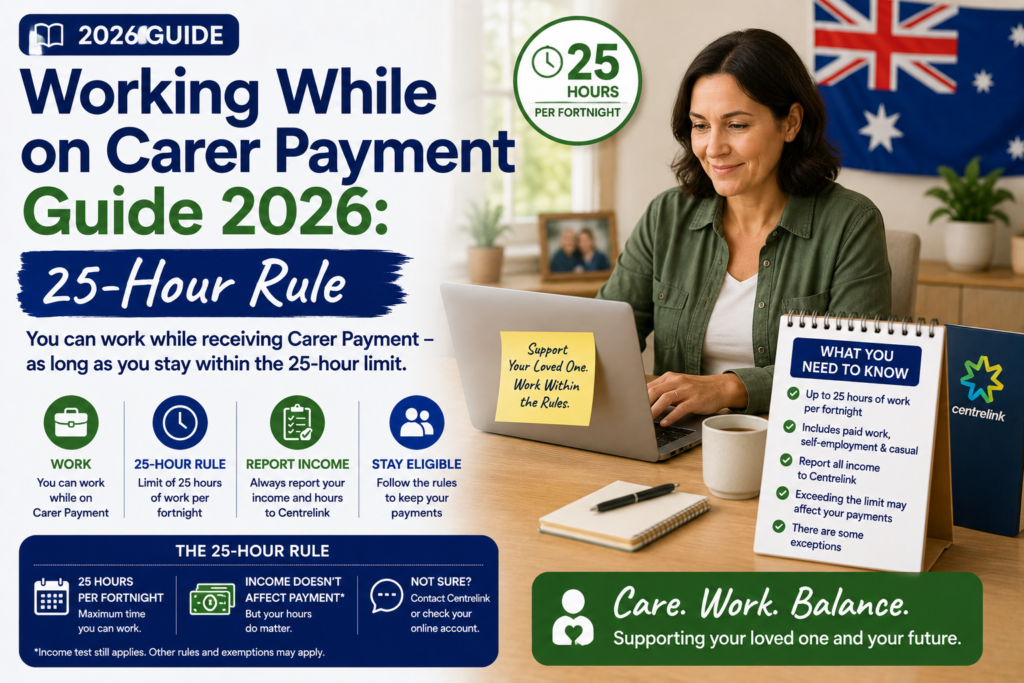
- The 25-Hour Limit: You can temporarily cease caring to work, volunteer, or study for a maximum of 25 hours per week.
- Travel Time Counts: The 25-hour limit includes the time it takes you to travel to and from your job or place of study. Failing to account for commute time is the most common reason carers lose their payment.
- Carer Payment vs. Carer Allowance: These rules apply specifically to the Carer Payment (an income support payment). The Carer Allowance is a supplementary payment and does not have the 25-hour work restriction.
- Income Testing: Even if you stay under 25 hours, the money you earn is subject to the Centrelink Income Test and will gradually reduce your fortnightly payment.
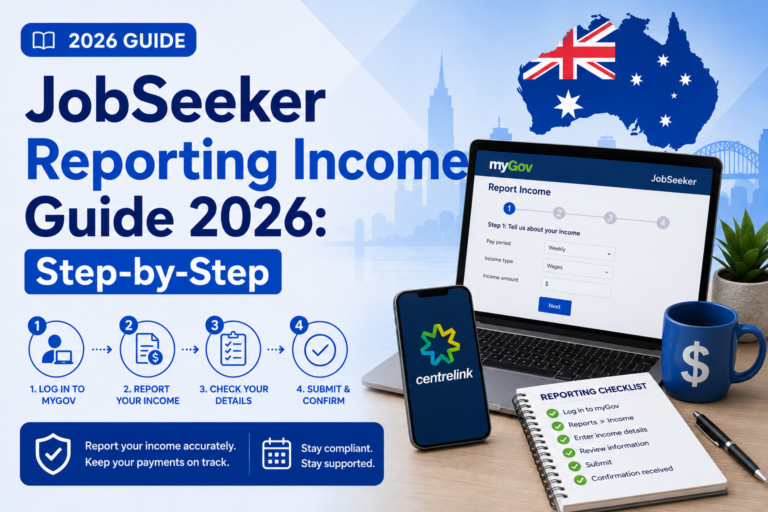
- Strict Reporting: You must log into your myGov account every 14 days to report the exact hours worked and your gross income.
Understanding the Carer Payment
Before exploring work restrictions, it is vital to distinguish between the two primary Centrelink carer benefits, as they have vastly different rules regarding employment.
1. Carer Payment: This is a primary income support payment (similar in structure to the Age Pension or Disability Support Pension). It is means-tested and paid to individuals who provide “constant care” to someone with a severe disability or medical condition. Because it replaces a full-time wage, it has strict limitations on how much external work you can perform.
2. Carer Allowance: This is a supplementary payment (a smaller, fixed fortnightly amount) paid in addition to your regular income. It is not income-tested and does not have a 25-hour work limit. You can work full-time (40 hours a week) and still receive the Carer Allowance, provided you still meet the care requirements for the person you look after.
If you are unsure which payment you are currently receiving, log into your Centrelink online account via myGov to check your payment summary. This guide applies strictly to recipients of the Carer Payment.
The 25-Hour Rule (Temporary Cessation of Care)
To qualify for the Carer Payment, you must provide “constant care.” Centrelink defines constant care as providing care for a significant period every day, equivalent to a normal working day. If you are working a full-time job, you mathematically cannot be providing constant care.
However, the legislation includes a provision for Temporary Cessation of Care. This provision allows you to step away from your caregiving duties to participate in training, education, paid employment, or voluntary work.
The golden rule is: You cannot be away from your caring role for these activities for more than 25 hours per week.
This 25-hour limit applies to any combination of work, volunteering, or study. For example, if you study at TAFE for 10 hours a week, you only have 15 hours left to undertake paid employment.
The Trap of Travel Time
The most devastating and frequently misunderstood aspect of the 25-hour rule is that it includes travel time.
The 25-hour limit does not just count the time you are physically clocked in at work or sitting in a lecture theatre. It counts the entire duration that you are absent from the person you are caring for.
Example Scenario:
Sarah works a part-time job at a retail store for 20 hours a week. It takes her 45 minutes to commute to work by bus, and 45 minutes to commute home.
– Total time at work: 20 hours.
– Total travel time per week (1.5 hours per day over 4 shifts): 6 hours.
– Total time absent from caring: 26 hours.
In this scenario, Sarah has breached the 25-hour rule, and Centrelink will cancel her Carer Payment. When negotiating part-time hours with an employer, you must rigorously calculate your commute to ensure your total absence remains safely under 25 hours.
How It Works: Income Testing
Staying under the 25-hour limit keeps you eligible for the payment, but the money you earn from that job will still affect how much Carer Payment you receive. The Carer Payment is subject to the Centrelink Income Test.
The Income Free Area
Every fortnight, you are permitted to earn a certain amount of money (the “Income Free Area”) before your Centrelink payment is reduced. This amount changes with indexation but is generally designed to allow for modest part-time earnings.
The Taper Rate
Once your gross income (your pay before tax) exceeds the Income Free Area, your Carer Payment will be reduced by a taper rate. Typically, for every dollar you earn over the limit, your pension is reduced by 50 cents.
If you earn a highly lucrative hourly wage, it is entirely possible to work only 15 hours a week but earn so much money that your Carer Payment reduces to zero for that fortnight. To understand how your specific hourly rate might impact your pension, we recommend using our Benefits Calculator.
Maximizing Income with the Working Credit
To encourage people on income support to take up casual or short-term work without immediately losing their benefits, Centrelink utilizes the Working Credit system.
If your total income is below the Income Free Area in a fortnight, you accrue Working Credits (up to a maximum balance of 1,000 credits).
When you eventually get a job or take on extra shifts, and your income exceeds the Income Free Area, Centrelink will deplete your Working Credits before they start reducing your Carer Payment. 1 Working Credit equals $1.
Example: If you have 500 Working Credits saved up, and you earn $300 over the limit this fortnight, Centrelink will deduct 300 credits from your balance, and your Carer Payment will remain untouched. This is incredibly beneficial for carers who only work during school holidays or take on occasional freelance gigs.
Step-by-Step Process: Managing Work and Care
If you are ready to take on part-time work or study, you must manage the transition carefully to avoid compliance issues.
- Calculate Your Absence: Before accepting a job offer or enrolling in a course, map out your travel route. Calculate the exact time you will leave the house and the exact time you will return. Ensure this total is firmly under 25 hours per week.
- Notify Centrelink: You must update your circumstances with Centrelink. Log into your myGov account and update your employment or study details. If you fail to declare that you have started working, you will incur a debt.
- Report Fortnightly: Once you start working, you will be placed on a strict 14-day reporting cycle. On your designated reporting day, you must declare the gross income your employer paid you during that specific 14-day period, as well as the hours worked.
- Ensure Care is Provided: Even though you are away for up to 25 hours, you must ensure that adequate care arrangements are in place for the person you look after while you are at work.
Documents Required
When you commence work while on Carer Payment, Centrelink may request documentation to verify your employment details and ensure you are complying with the rules.
- Payslips: You should keep every payslip. Centrelink may request these at any time to verify that your reported gross income matches your actual earnings.
- Employment Contract/Letter: In some cases, Centrelink may request a letter from your employer confirming your average weekly hours and your standard place of work (to verify travel times).
- Proof of Enrolment: If you are using your 25 hours to study, you will need to provide an official document from your university or TAFE confirming your course load and contact hours.
To learn more about how to securely upload these documents to the Centrelink portal, read our Application Support Guide.
What Happens if You Exceed 25 Hours?
What happens if your boss asks you to stay late, or you get stuck in massive traffic, pushing your total absence to 26 hours for a single week?
The rules are rigid. If you exceed the 25-hour limit in a week, you have breached the condition of “constant care.” Generally, your Carer Payment will be suspended for that period. If you regularly exceed 25 hours, Centrelink will determine that you are no longer eligible for the payment, and it will be cancelled entirely.
The Respite Exception: You are granted 63 days of “Respite” every calendar year. Respite days allow you to take a complete break from caring (for example, going on a holiday) while still receiving your payment. If you know you are going to work 40 hours for one specific week, you can technically use your allocated Respite days to cover that absence without losing your payment. However, once your 63 days are exhausted, the strict 25-hour rule applies relentlessly.
Common Mistakes and Delays
Avoid these frequent errors that lead to suspended payments and Centrelink debts:
- Reporting Net Instead of Gross: Always report the amount you earned before tax was deducted. Reporting the money that actually hit your bank account is a breach of rules.
- Averaging Hours Over a Fortnight: The 25-hour rule applies per week, not per fortnight. You cannot work 40 hours one week and 10 hours the next. If you hit 40 hours in week one, you breach the rule and lose your payment.
- Forgetting Remote Work Rules: If you work from home (e.g., freelance writing on a laptop while sitting next to the person you care for), the hours you spend working still count toward the 25-hour limit, because Centrelink considers you to be “temporarily ceasing care” while you are focused on employment.
- Not Utilizing Digital Tools: Avoid calling Centrelink to report your income. Use the Express Plus Centrelink App to report your wages in seconds and avoid long phone wait times.
Frequently Asked Questions
Can I work full-time on the Carer Payment?
No. If you work full-time (standard 38-40 hours a week), you cannot meet the requirement of providing “constant care.” Your Carer Payment will be cancelled. However, you may still be able to receive the Carer Allowance if you work full-time.
Does travel time really count towards the 25 hours?
Yes, absolutely. The 25-hour limit encompasses the total time you are absent from the person you are caring for. This includes the time spent commuting to and from your workplace or educational institution.
What if I work from home? Do the 25 hours still apply?
Yes. Even if you are physically in the same house as the person you care for, time spent working from home or studying online counts towards the 25-hour limit, as you are engaged in an activity other than providing constant care.
Will my Carer Payment be reduced if I work?
It depends on how much you earn. If your gross wages are below the Income Free Area, or if you have enough Working Credits saved up, your payment will not reduce. Once you earn above these thresholds, your payment will gradually reduce by the taper rate.
Official Resources
For the most current income thresholds, taper rates, and official policy regarding temporary cessation of care, always refer directly to the government portal:
Conclusion
Balancing employment with the immense responsibility of caregiving is challenging, but it is entirely possible under Centrelink regulations. Working part-time while receiving the Carer Payment provides vital social connection, career continuity, and a welcome boost to your household income.
The key to maintaining this balance without triggering a Centrelink debt is strict adherence to the 25-Hour Rule. You must be hyper-vigilant about your schedule, always factoring in your commute time, and ensuring you never exceed the weekly limit. Coupled with meticulous fortnightly reporting of your gross income via your myGov account, you can safely navigate the system.
If your circumstances change, or if you find the 25-hour limit too restrictive for your career goals, you may need to transition off the Carer Payment and explore other income support options while maintaining the supplementary Carer Allowance.
Disclaimer
PublicServicesDesk.com is an independent informational website and is not affiliated with, endorsed by, or operated by the Australian Government, Services Australia, Centrelink, Medicare, MyGov, the Australian Taxation Office (ATO), or the Department of Home Affairs. Information is provided for general educational purposes only and may change over time. Always verify important details through official Australian Government websites before making decisions or submitting applications.