EI Regular vs. Special Benefits Canada 2026: Key Differences Explained
Navigating Employment Insurance (EI) can feel complex, especially when you need to understand the difference between EI regular benefits and EI special benefits. Both provide essential financial support, but they serve completely different purposes and have distinct rules for eligibility, duration, and how they interact with one another.
This guide breaks down everything you need to know about EI regular vs. special benefits in Canada for 2026. We’ll explain what each type covers, the key differences in how they work, and why understanding the distinction between regular and special benefits could be crucial if your circumstances change while you’re on a claim[citation:8][citation:10].
⚡ Key Takeaway: The fundamental difference between EI regular vs. special benefits lies in their purpose and flexibility. Regular benefits support you while you look for work after losing your job through no fault of your own. Special benefits support you during specific life events like illness, pregnancy, or caregiving. Crucially, the 52-week maximum benefit period is fixed for regular benefits but can be extended for special benefits, allowing for consecutive claims[citation:8][citation:10].
What Is Employment Insurance (EI)?
Employment Insurance is a federal program in Canada that provides temporary financial assistance to eligible workers who are unemployed or need time off for specific life events[citation:1][citation:4]. Both employees and employers contribute to the EI program through payroll deductions[citation:1][citation:4].
When you apply for EI, the type of benefit you receive depends entirely on your reason for needing it. This is where the distinction between EI regular vs. special benefits becomes critical[citation:1][citation:4].
What Are EI Regular Benefits?
EI regular benefits are designed for individuals who have lost their job through no fault of their own and are actively looking for new work[citation:1][citation:4][citation:5]. This is the most common type of EI claim.
When Do You Claim Regular Benefits?
- Layoff or shortage of work: Your employer reduced staff, closed, or doesn’t have enough work[citation:5].
- Seasonal employment: You work in a seasonal job and are between seasons[citation:5].
- Company restructuring or downsizing: Your position was eliminated[citation:4].
Qualifying for EI Regular Benefits
To qualify for EI regular benefits, you must meet specific requirements[citation:4][citation:11]:
- Insurable hours: You need between 420 and 700 insurable hours in the last 52 weeks, depending on the unemployment rate in your region[citation:4][citation:5][citation:11].
- Involuntary job loss: You lost your job through no fault of your own. Voluntary quitting without “just cause” or being dismissed for misconduct makes you ineligible for regular benefits[citation:4][citation:11].
- Availability and job search: You must be ready, willing, and capable of working each day, and you must be actively searching for work[citation:4][citation:5].
📌 Job Search Record
Service Canada requires you to keep a written record of the employers you contact. This includes the date, the company, the person you spoke with, and the outcome of the contact. You may be asked to provide this record at any time[citation:5][citation:11].
Duration and Benefit Rate
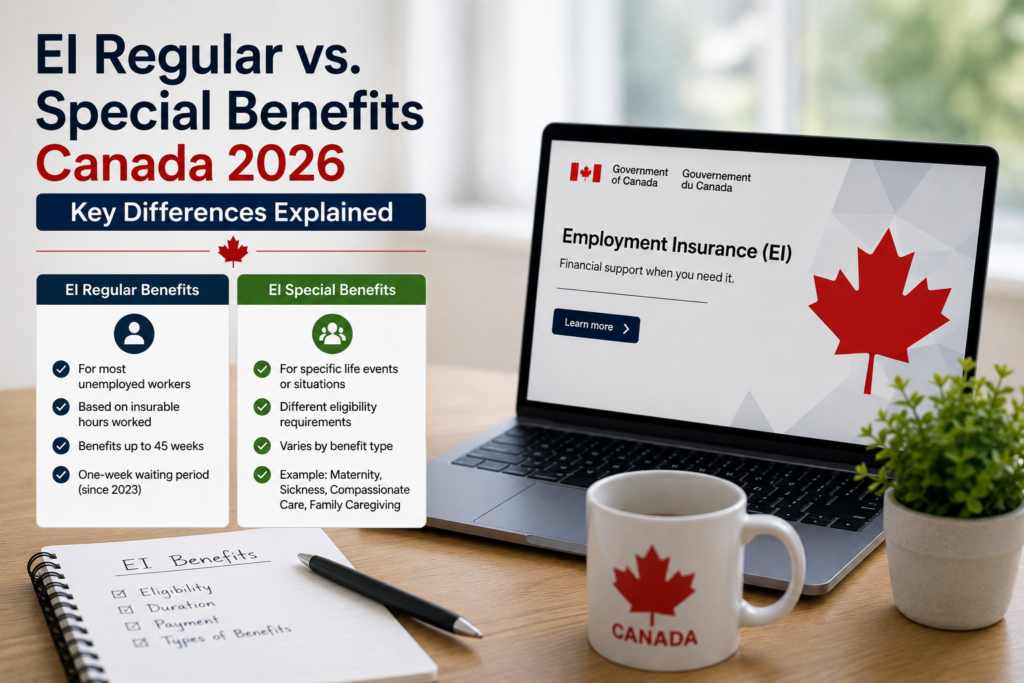
The benefit rate for EI regular benefits is 55% of your average insurable weekly earnings, up to a maximum weekly amount[citation:4][citation:12]. For 2026, the maximum weekly benefit is $729, up from $695 in 2025[citation:4]. The duration of your claim—how many weeks you can receive benefits—ranges from 14 to 45 weeks, depending on the number of insurable hours you have and the unemployment rate in your region[citation:4].
What Are EI Special Benefits?
EI special benefits cover a range of life events where you need time away from work but are not unemployed and looking for a job[citation:1][citation:8]. These benefits have different eligibility rules and are often designed to be more flexible than regular benefits.
Types of EI Special Benefits
There are several categories of EI special benefits[citation:1][citation:4][citation:7]:
- Sickness Benefits: Provide short-term financial assistance if you cannot work due to a medical condition, injury, or quarantine. You can receive up to 26 weeks of sickness benefits[citation:4][citation:8].
- Maternity and Parental Benefits: Support new parents during pregnancy, childbirth, or adoption. There are 15 weeks of maternity benefits for birth mothers, and standard (40 weeks) or extended (69 weeks) parental benefits that can be shared between parents[citation:1][citation:4][citation:7].
- Caregiving Benefits: For those caring for a critically ill or injured family member. This includes compassionate care benefits (26 weeks for end-of-life care), and benefits for caregivers of critically ill adults (15 weeks) or children (35 weeks)[citation:1][citation:4][citation:7].
- Fishing Benefits: For self-employed fishers who need income support during periods when work is not available[citation:1][citation:4].
- Benefits for the Self-Employed: Self-employed individuals who register and pay EI premiums for 12 months can access special benefits, though they are not eligible for regular EI benefits[citation:4].
Qualifying for EI Special Benefits
The eligibility requirements for EI special benefits are different from regular benefits[citation:4][citation:8]:
- Insurable hours: You typically need a minimum of 600 insurable hours in your qualifying period, which is generally higher than the minimum for regular benefits[citation:4][citation:8].
- Reduction in earnings: You must experience a reduction in your normal weekly earnings of over 40%[citation:8][citation:10].
- Specific criteria: Each type of special benefit has its own criteria. For example, sickness benefits require a medical certificate, while maternity benefits require proof of pregnancy[citation:4][citation:7].
EI Regular vs. Special Benefits: Key Differences
The distinction between EI regular vs. special benefits goes beyond just the reason for your claim. The most critical difference lies in the rules around the 52-week benefit period and the ability to claim multiple benefits consecutively[citation:8][citation:10].
| Feature | EI Regular Benefits | EI Special Benefits |
|---|---|---|
| Purpose | Support while looking for work after losing your job | Support during specific life events (illness, pregnancy, caregiving) |
| Reason for Claim | Layoff, shortage of work, seasonal end | Sickness, pregnancy, adoption, caregiving, fishing |
| Insurable Hours Required | 420 – 700 hours (based on regional unemployment) | 600 hours |
| Benefit Rate | 55% of average insurable earnings (max $729/week in 2026) | 55% of average insurable earnings (max $729/week in 2026) |
| Maximum Duration | 14 – 45 weeks | Varies by type: sickness (26 weeks), maternity (15), parental (40/69), caregiving (15-35), etc. |
| 52-Week Benefit Period | Fixed. Once the first payment is issued, the 52-week period cannot be paused, extended, or restarted. | Flexible. Extensions are possible. Multiple types of special benefits can be claimed consecutively. |
| Requalifying | You must work enough insurable hours to requalify within the fixed 52-week period. | You may be able to transition directly from one special benefit to another without requalifying. |
⚠️ The 52-Week Rule: A Critical Distinction
The most important difference between EI regular vs. special benefits is how the 52-week benefit period works[citation:8][citation:10].
For regular benefits: Once your claim is established, you have a fixed 52-week period to collect your 14-45 weeks of benefits. If you find short-term work and are laid off again within that 52-week period, you cannot start a new claim for regular benefits. You simply continue on the original claim. If you exhaust your benefits and haven’t requalified with new insurable hours, you have no access to regular benefits, even if you remain unemployed beyond the 52-week mark[citation:8][citation:10].
For special benefits: The rules are more flexible. You can claim multiple types of special benefits consecutively within or even beyond the original 52-week period. For example, a person could claim maternity benefits, then parental benefits, and then, if they develop a medical condition, claim sickness benefits without needing to requalify, as long as they meet the criteria for each benefit type. The Social Security Tribunal has affirmed this flexibility in cases where a claimant developed an illness during their parental leave and was entitled to sickness benefits even after the original benefits period had expired[citation:8][citation:10].
Can You Claim Both EI Regular and Special Benefits?
Yes, it is possible to receive both EI regular and special benefits, but usually not at the same time. Here’s how they can interact:
Transitioning from Regular to Special Benefits
If you are receiving regular EI benefits and then experience a qualifying life event like a serious illness, you can transition from regular benefits to sickness benefits. This does not start a new claim; the special benefits are paid out within the same 52-week benefit period as your regular claim. The total duration of combined benefits will still be within the 52-week limit[citation:8][citation:10].
Transitioning from Special to Regular Benefits
If you are receiving special benefits (e.g., parental leave) and your job is eliminated while you are on leave, you may be eligible for regular benefits. However, the same 52-week rule applies. The regular benefits you are entitled to will be paid within the original 52-week benefit period[citation:8].
Frequently Asked Questions About EI Regular vs. Special Benefits
Expert Tips for Navigating EI Regular vs. Special Benefits
- Apply as soon as you stop working: Don’t delay your application for EI regular or special benefits. Late applications can result in lost weeks of benefits[citation:9].
- Keep your job search record: For EI regular benefits, maintain a detailed written record of your job search activities[citation:4][citation:5].
- Understand the 52-week rule: When planning your claim, remember that the 52-week benefit period is a hard limit for regular benefits. If you anticipate needing multiple types of benefits, be strategic about when you start your claim[citation:8][citation:10].
- Seek professional advice if needed: If your situation is complex, such as needing to transition between regular and special benefits, consider consulting a tax professional or employment lawyer[citation:8].
- Check the official Service Canada website: Eligibility rules and benefit amounts can change. Always verify current information on the official Government of Canada EI page.
✅ Need Help With Your EI Claim? Understanding the distinction between EI regular vs. special benefits can make a significant difference in your financial planning. Apply online through My Service Canada Account. For official information, always refer to the Government of Canada’s EI page.
📢 Disclaimer: PublicServicesDesk.com is an independent information platform and is not affiliated with Service Canada, Employment and Social Development Canada (ESDC), or any Government of Canada department. All guides are for educational purposes only. For official transactions, always refer to canada.ca/ei.
Last updated: July 2026