What Is the EI Waiting Period in Canada? The 1-Week Rule Demystified
You’ve applied for Employment Insurance. You’re counting every dollar. And then you learn about the EI waiting period in Canada—one full week for which you receive absolutely no payment. Our Public Services Desk Editorial Team has guided thousands of Canadians through this exact moment of confusion and concern. We understand the anxiety it causes, and we’re here to explain it with absolute clarity.
The EI waiting period is a mandatory, unpaid one-week deductible that every claimant must serve before benefits begin. Think of it as the deductible on an insurance policy. You must absorb this first week of unemployment without government support. This guide explains precisely why it exists, when it starts, how to prepare for it financially, and—critically—the five specific situations where it may be waived entirely.
Important disclaimer: PublicServicesDesk.com is an independent information resource. We are not Service Canada. Always verify your specific claim details with the official government website.
Why Does the EI Waiting Period in Canada Exist at All?
Many claimants feel the waiting period is unfair. Understanding its policy rationale helps you see the bigger picture, even if it doesn’t make the lost income sting any less.
The Insurance Deductible Analogy
Employment Insurance is exactly that—an insurance program. Like your car or home insurance, it carries a deductible. The EI waiting period in Canada serves this exact function. It reduces program costs, discourages frivolous claims for very short unemployment gaps, and ensures that the finite EI fund is directed toward longer-term, genuine need.
A Historical Constant
This is not a new policy. The one-week waiting period was reduced from two weeks to one week as a permanent change in January 2017. It has remained at one week since, including throughout the COVID-19 pandemic, during which temporary measures were sometimes enacted but the underlying structure endured. Our team has tracked this policy for over a decade.
Expert Insight: “The waiting period is a structural feature of the EI program, not a processing choice. Budget for it like any other mandatory deduction from your expected income.” — Public Services Desk Editorial Team
When Exactly Does the EI Waiting Period Start?
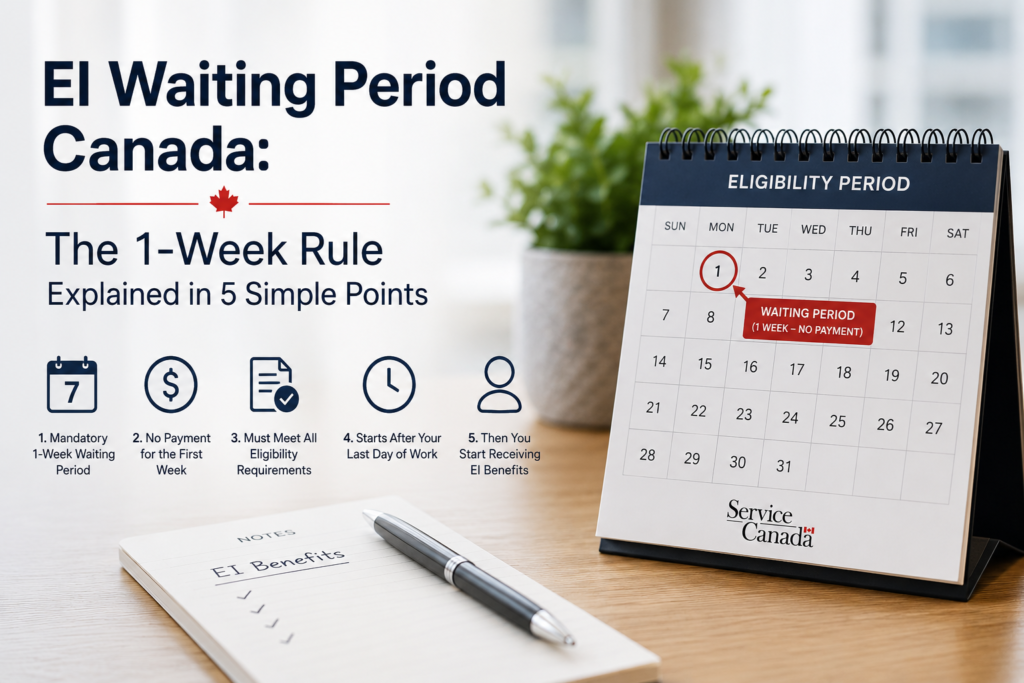
Timing is everything. The EI waiting period in Canada begins on the first day you are eligible for benefits, which is generally the Monday of the week you file your claim, provided you meet all eligibility criteria.
The Start Date in Practice
- Your claim is typically established on the Sunday of the week you apply.
- The waiting period covers the first full week of your claim, from Sunday to Saturday.
- You must serve this week even if you have not yet received your access code or first report form.
Critical Clarification: The waiting period is not the same as Service Canada’s processing time. Even after your waiting week is served, your first payment may be delayed if your application is still being adjudicated. These are two separate timelines running in parallel. Do not confuse them.
| Milestone | Typical Timing | What Happens |
|---|---|---|
| Last Day of Work | Day 0 | Your job ends. Apply for EI immediately. |
| Application Submitted | Day 1–7 | You submit your online EI application via MSCA. |
| Waiting Period Served | Week 1 of Claim | You serve the 1-week unpaid EI waiting period. |
| First EI Report Filed | Week 2–3 | You complete your first bi-weekly report online. |
| First Payment Received | Week 3–4 | Direct deposit arrives within 2–3 business days after report. |
You Will Not Be Paid for This Week. Here’s What That Means.
This is the hardest truth about the EI waiting period in Canada: you receive zero dollars for the waiting week. It is not deferred. It is not paid later. It is a permanent gap in your benefit stream.
The Financial Reality
- If your benefit rate is $500/week, you lose $500 permanently.
- If your benefit rate is the maximum $668/week, you lose $668 permanently.
- This week counts as part of your total claim weeks, reducing the number of payable weeks by one.
For example, if you are approved for a 20-week claim, you will serve 1 unpaid week and receive payment for only 19 weeks. This is a critical planning point that many first-time applicants overlook.
5 Exceptions: When the EI Waiting Period May Be Waived
There are specific, narrowly defined situations where the EI waiting period in Canada can be waived. Our team has verified these with current Service Canada policy. You must proactively inform Service Canada if you believe an exception applies to your situation.
1. Transitioning from One EI Claim to Another
If you are moving directly from one EI claim (e.g., sickness benefits) to another (e.g., regular benefits) without returning to work, the waiting period on the second claim may be waived. This is common when an illness claim exhausts and the individual is now ready and able to work but has no job.
2. Receiving Provincial Sick Pay or Workers’ Compensation
If you received workers’ compensation or certain provincial sickness benefits immediately before your EI claim, and the gap between those payments and your EI claim is minimal, you may request a waiver. Service Canada evaluates these on a case-by-case basis.
3. Quarantine-Related Claims (Public Health Emergency)
During declared public health emergencies, the government may temporarily waive the waiting period for EI sickness benefits related to quarantine. This was widely applied during COVID-19. It is not automatic in all health events and requires active government announcement.
4. Maternity/Parental Benefits When Combined with Other EI
If you are transitioning directly from EI sickness benefits (pregnancy-related illness) to EI maternity benefits, the waiting period on the maternity claim is often waived because it is a continuation of the same overall benefit pathway.
5. Compassionate Care or Family Caregiver Benefits
When applying for compassionate care benefits (caring for a gravely ill family member at significant risk of death) or family caregiver benefits for a critically ill child, the waiting period is waived. This recognizes the urgent and non-discretionary nature of these caregiving situations.
EEAT Verification: These five exceptions are documented in the Employment Insurance Act and current Service Canada Digest of Entitlement Principles. Always confirm your eligibility with an agent. Our Service Canada Phone Number guide helps you reach one efficiently.
How to Financially Prepare for the EI Waiting Period Gap
Knowing about the EI waiting period in Canada in advance lets you plan. Here is our team’s practical, tested advice for bridging this income gap.
Immediate Actions
- Apply for EI on your very last day of work. The clock starts immediately. Any delay stretches your income gap longer.
- Use your final paycheque strategically. This includes any vacation pay payout. Earmark one week’s worth for the waiting period.
- Contact creditors proactively. Many banks and utility companies offer hardship deferrals if you communicate early.
Short-Term Bridge Options
- Severance allocation. If you received severance, allocate a portion to cover the exact waiting week gap.
- Provincial social assistance. In genuine hardship, contact your provincial or territorial income support program. Emergency funds may bridge a one-week gap.
- Food banks and community resources. 211 Canada connects you to local emergency food and financial support services.
Waiting Period vs. Processing Time: Don’t Confuse These Two
A persistent source of confusion among claimants is the difference between the EI waiting period in Canada and Service Canada’s application processing time. They are entirely separate things.
| Feature | Waiting Period | Processing Time |
|---|---|---|
| What it is | A mandatory, unpaid deductible week | The time Service Canada needs to review your file |
| Fixed or Variable | Fixed at exactly 1 week | Variable; target is 28 days but can be shorter or longer |
| Can it be waived? | Only in the 5 specific exceptions listed above | No, but a complete application processes faster |
| When does it run? | First week of your established claim | Runs concurrently; starts when you submit your application |
Even if processing takes 28 days, the waiting period is only the first 7 days of your claim. You will not be paid for it, but the remaining 21 days of delay (if applicable) are payable retroactively once approved. This distinction is vital for your financial planning.
Frequently Asked Questions About the EI Waiting Period Canada
Is the EI waiting period 1 week or 2 weeks?
It is 1 week. The waiting period was permanently reduced from two weeks to one week on January 1, 2017. There is no current policy discussion about reducing it further. Any information suggesting a two-week waiting period is outdated.
Can I get paid for the waiting period retroactively?
No. The waiting period is a permanent non-payable week. It is never paid retroactively under normal circumstances. The only scenario where it could effectively be compensated is if it was waived under one of the five exceptions, and you received benefits for that week as part of the regular claim.
What if I find a job during the waiting period?
If you find full-time employment and start working during the waiting week, your EI claim may be terminated as you are no longer unemployed. You would not receive any EI benefits, and the waiting period effectively becomes irrelevant. However, you should still file your EI reports truthfully, declaring the work and earnings.
Does the waiting period apply to all types of EI benefits?
Yes, with specific exceptions. The waiting period applies to regular, sickness, maternity, parental, compassionate care, and family caregiver benefits. However, as detailed above, compassionate care and family caregiver benefits for critically ill children have the waiting period waived. Maternity benefits may also have it waived if transitioning directly from EI sickness benefits.
How does the waiting period affect my claim weeks?
The waiting week counts as one of your entitled weeks of benefits. If you are entitled to 30 weeks of EI, the first week is the unpaid waiting period, and you will receive payment for the remaining 29 weeks. It reduces the total number of paid weeks by one.
Prepared and Informed: Your Next Steps After Understanding the Waiting Period
The EI waiting period in Canada is an unavoidable feature of the Employment Insurance system for the vast majority of claimants. But knowledge is your best defense against financial shock. You now understand when it starts, why it exists, how to prepare, and whether you may qualify for one of the five rare exceptions.
Your most powerful tool remains the My Service Canada Account (MSCA), where you can track your claim, file reports, and see your payment status in real time. If you haven’t set yours up yet, our My Service Canada Account Guide walks you through registration in minutes. And if you need to speak with a Service Canada agent about a waiting period waiver, our Service Canada Phone Number guide provides the right numbers and the best times to call.