How to Apply for EI in Canada: Your Complete 5-Step Guide
Losing your job or needing time off for family, illness, or a new child is stressful enough. The last thing you need is confusion about how to apply for EI in Canada. Our Public Services Desk Editorial Team has helped thousands of Canadians navigate the Employment Insurance system successfully. We’ve seen exactly what causes claims to be delayed or denied, and we’ve distilled that hard-won knowledge into this definitive, plain-language guide.
This is not the official government website. We are an independent resource with deep subject-matter expertise. Our mission is to make the official process faster and clearer for you. By following our 5 verified steps, you will submit a complete, accurate application the first time—maximizing your chance of a smooth approval and a fast first payment.
Step 1: Check Your EI Eligibility Before You Apply
The first and most critical step in understanding how to apply for EI in Canada is confirming you meet the eligibility criteria. A denied claim often traces back to an eligibility issue that could have been identified upfront. Here is what Service Canada requires:
The Core Eligibility Test
- You were employed in insurable employment. This means your employer deducted EI premiums from your paycheque.
- You lost your job through no fault of your own. Layoffs, shortage of work, and seasonal contract ends qualify. Being fired for misconduct generally does not.
- You have accumulated enough insurable hours. The number varies by region, typically between 420 and 700 hours in the last 52 weeks. Check your region’s rate on the official website.
- You are ready, willing, and capable of working each day. You must be actively looking for a new job.
- You have been without work and without pay for at least 7 consecutive days.
Expert Tip: The regional unemployment rate directly impacts the required hours. If you live in an area with higher unemployment, you may qualify with fewer hours. Use the official EI Economic Region tool to see your exact threshold.
Step 2: Understand Your Record of Employment (ROE)
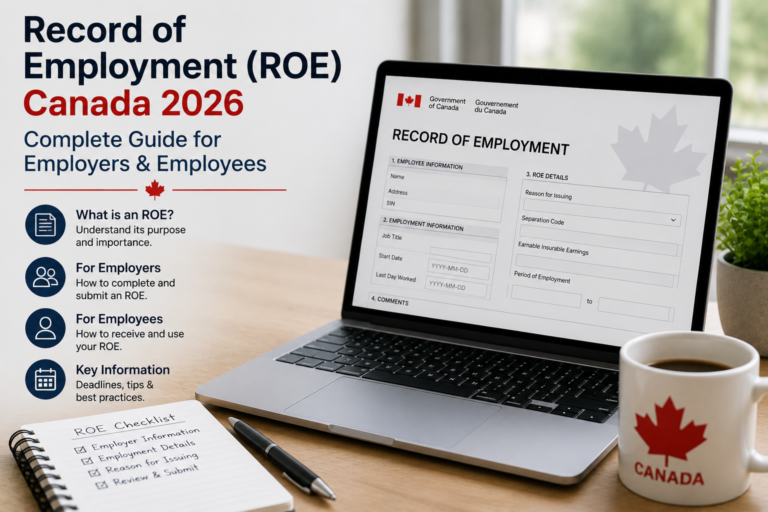
Your Record of Employment (ROE) is the single most important document in your EI application. It is the official form your employer issues that details your insurable hours and earnings. Without it, Service Canada cannot calculate your claim.
How to Get Your ROE
- Electronic ROE: Most employers now submit ROEs directly to Service Canada electronically. You can view these instantly by logging into your My Service Canada Account (MSCA).
- Paper ROE: If your employer gives you a paper copy, you must keep it safe. You will need to provide the serial number and details from it when you apply. You may also be asked to mail the original to Service Canada.
Critical Warning: Do not delay your application while waiting for your ROE. Apply for EI as soon as you stop working. You can file your claim without the ROE, and Service Canada will retrieve it. Delaying your application beyond 4 weeks after your last day of work can result in a loss of benefits. This is the number one mistake we see.
Step 3: Gather These Essential Documents Before You Start
Learning how to apply for EI in Canada efficiently means showing up prepared. The online application takes approximately 60 minutes to complete. You cannot save your progress. Have these items at your desk before you begin:
Personal Identification
- Your Social Insurance Number (SIN)
- A piece of government-issued photo ID
- Your mother’s maiden name
Employment Information
- Your Record of Employment (if you have it)
- Names and addresses of all employers from the last 52 weeks
- Dates of employment and reason for separation for each job
Financial Details
- Your banking information (a void cheque for direct deposit)
- Details of any separation payments (severance, vacation pay, etc.)
Additional (If Applicable)
- A medical certificate (for sickness benefits)
- Date of birth or due date (for maternity/parental benefits)
Step 4: How to Apply for EI in Canada Online (The Only Method We Recommend)
While phone and in-person applications technically exist, the online application through your My Service Canada Account (MSCA) is the fastest, most accurate, and only method we recommend. It is available 24/7.
Your Online Application Checklist:
- Log in to your My Service Canada Account. If you don’t have one, you can register in minutes.
- Locate and select the “Apply for Employment Insurance Benefits” link.
- Carefully read each question and answer truthfully. Errors can be flagged as misrepresentation and lead to penalties.
- Complete all sections, including your work history, reason for separation, and banking information for direct deposit.
- Review your entire application on the summary page before submitting. Look for typos, especially in dates and dollar amounts.
- Submit and write down your confirmation number. This is your proof of application.
After submitting, you will receive a Benefit Statement letter in the mail or in your MSCA inbox within 7–10 days. This letter confirms your claim details and the date of your first report.
Step 5: The Waiting Period and Your First EI Report
Understanding what happens after you submit is a vital part of how to apply for EI in Canada successfully.
The 1-Week Waiting Period
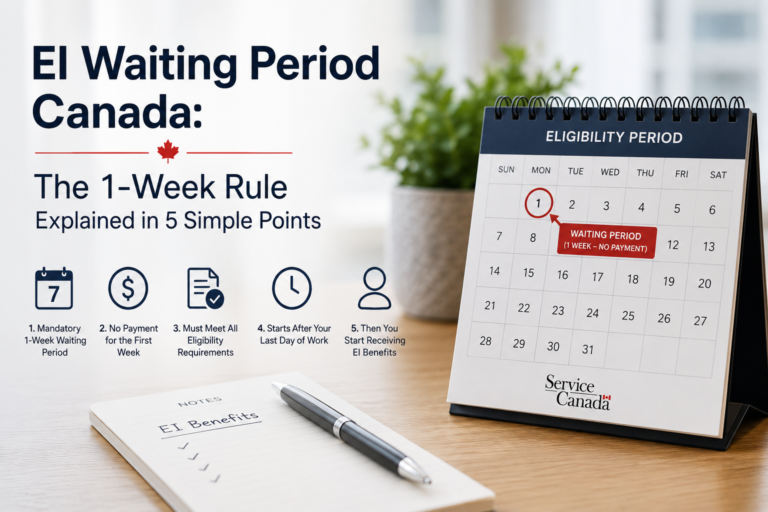
There is a mandatory one-week waiting period for which no benefits are paid. Think of this as a deductible for your EI claim. This waiting period starts immediately after you file your claim and are deemed eligible. You must serve this week before any payments are issued.
Completing Your Bi-Weekly Reports
To continue receiving benefits, you must complete your bi-weekly EI reports online or by phone. These reports confirm you are still eligible. You cannot receive payment for any week you fail to file a report. Missing a report is the fastest way to interrupt your benefit stream.
You will need a four-digit EI Access Code to file your reports. Service Canada mails this to you shortly after you apply. Keep it safe; you’ll use it every two weeks.
How Much EI Will You Receive? Calculating Your Benefit Rate
The question on everyone’s mind when learning how to apply for EI in Canada is: “How much will I get?” The basic calculation is straightforward.
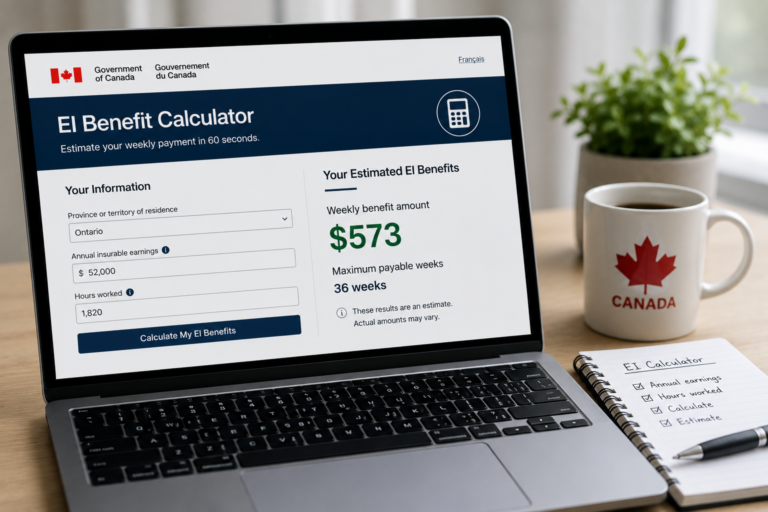
The standard EI benefit rate is 55% of your average insurable weekly earnings, up to a maximum amount. As of 2024, the maximum yearly insurable earnings amount is $63,200, which means the maximum weekly EI benefit is $668 per week.
For low-income families with children, the Family Supplement can increase your benefit rate up to 80% of your insurable earnings. You must apply and meet the net income threshold to qualify.
Use our EI Benefit Amount Estimator tool to get a personalized estimate of your weekly payment in under two minutes.
Regular vs. Special Benefits: Which One Applies to You?
Knowing how to apply for EI in Canada also means knowing which type of benefit you need. Service Canada offers two main categories:
| Benefit Type | When to Apply | Maximum Weeks Payable |
|---|---|---|
| Regular Benefits | Laid off, shortage of work, seasonal job ended | 14 to 45 weeks (based on regional unemployment rate) |
| Sickness Benefits | Unable to work due to illness, injury, or quarantine | Up to 26 weeks |
| Maternity Benefits | Pregnant or recently gave birth | Up to 15 weeks |
| Parental Benefits (Standard) | Caring for a newborn or newly adopted child | Up to 40 weeks (one parent cannot exceed 35 weeks) |
| Parental Benefits (Extended) | Caring for a newborn or newly adopted child at a lower rate | Up to 69 weeks (one parent cannot exceed 61 weeks) |
| Caregiving Benefits | Caring for a critically ill or injured family member | Up to 26 weeks |
Read our detailed comparison guide: EI Regular vs Special Benefits Explained.
7 Common Mistakes That Cause EI Claim Rejection
We have analyzed hundreds of denied claims to identify the patterns. Knowing how to apply for EI in Canada successfully means avoiding these pitfalls:
- Waiting too long to apply. Apply within 4 weeks of your last day of work. Delays can result in lost benefits.
- Quitting voluntarily without just cause. Quitting a job without a provable, legally recognized reason makes you ineligible.
- Inaccurate or incomplete work history. Forgetting a short-term job from the last 52 weeks can delay your claim.
- Not reporting all separation income. Severance, vacation pay, and bonuses must be declared. Service Canada will find out.
- Being unavailable for work. If you travel, attend school full-time, or cannot accept a job immediately, your benefits stop.
- Missing bi-weekly reports. A single missed report suspends your payment until it’s filed.
- Not keeping a personal record of your job search. Service Canada can ask for proof. Keep a log of jobs applied to, dates, and contacts.
Frequently Asked Questions About EI Applications
How long does it take for an EI application to be processed?
Service Canada aims to process a complete EI application within 28 calendar days. If you provided all necessary information and your ROE is on file, you can often receive your first payment within 2-3 weeks after the waiting period. Incomplete applications are the main cause of delays.
Can I apply for EI if I quit my job?
Generally, no. Quitting voluntarily disqualifies you unless you can prove “just cause“—a legally recognized reason such as sexual harassment, discrimination, unsafe working conditions, or a forced change in job duties that significantly alters your employment contract. This is a high legal bar to meet. Document everything.
What happens if my EI application is denied?
You have the right to request a reconsideration within 30 days of receiving the denial decision. This is a formal review by a different Service Canada agent. If the reconsideration is also denied, you can appeal to the Social Security Tribunal, an independent body. We strongly recommend gathering all supporting documents before requesting reconsideration.
Can I work part-time while on EI?
Yes, you can work while receiving EI benefits, but you must declare all earnings on your bi-weekly report. A portion of your earnings will be deducted from your benefit. The “Working While on Claim” rules allow you to keep 50 cents of your benefits for every dollar you earn, up to 90% of your previous insurable earnings. This is designed to encourage you to take available work.
Your Roadmap to a Successful EI Application
You now understand exactly how to apply for EI in Canada. The path is clear: verify your eligibility, gather your documents, apply online within 4 weeks, and file your bi-weekly reports without fail. This system exists as your financial safety net, but it requires your informed participation to work.
The Public Services Desk Editorial Team is committed to keeping this guide updated as policies evolve. Save this page, share it with someone who needs it, and remember that the official application portal is your direct line to benefits. We simply light the way.