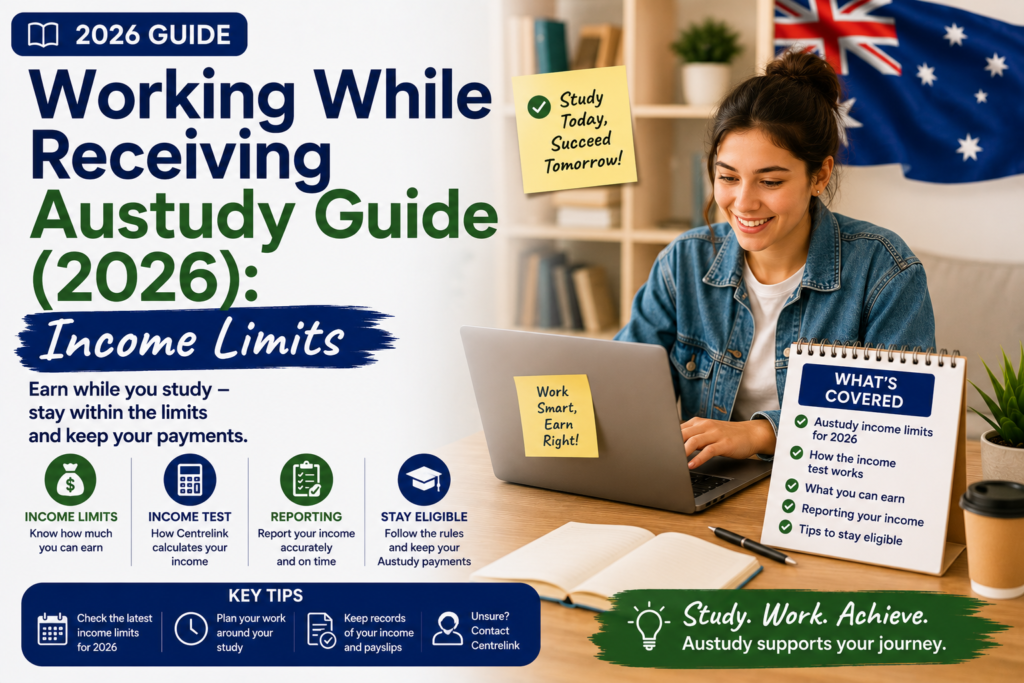
Working While Receiving Austudy Guide: Rules & Income Limits in 2026
Returning to study or starting an apprenticeship later in life requires immense dedication. For Australians aged 25 and over, the government provides financial support through Austudy. This payment is designed to alleviate the financial burden of full-time education for mature-age students who likely have higher living expenses—such as independent housing, car loans, or families to support—than recent high school graduates.
However, the reality for the vast majority of mature-age students is that the base rate of Austudy is simply not enough to survive on alone. To pay the rent and keep the lights on, taking on part-time or casual employment is not just an option; it is a necessity.
This reality prompts one of the most frequently asked questions: Can I work while receiving Austudy without my payments being cut off?
The answer is a resounding yes, but the process is governed by a strict set of rules known as the Centrelink Income Test. The government uses a highly effective mechanism called the “Student Income Bank” to ensure that you are not unfairly penalized for taking on extra shifts during the holidays. Yet, failing to understand how to correctly report your gross wages, or letting your work hours interfere with your full-time study load, can result in immediate payment suspensions and severe financial debts.
In this comprehensive Working While Receiving Austudy Guide, we will break down the mechanics of the Income Bank, explain exactly how your wages reduce your fortnightly payment, outline the reporting process via myGov, and detail the common mistakes that can jeopardize your Centrelink support.
Key Takeaways
- Work is Encouraged: You are actively permitted to work part-time or casually while receiving Austudy, provided your employment does not cause you to drop below a full-time study load.
- The Student Income Bank: This is your financial safety net. It allows you to accrue “credits” when you aren’t working, which you can then use to offset high earnings during busy periods (like the summer holidays).
- Gross Income Reporting: You are legally required to log into your account every 14 days and report your gross income (the amount earned before tax), not the net amount that lands in your bank account.
- Partner Income Matters: Unlike Youth Allowance, Austudy recipients are independent. However, if you live with a partner, your Austudy is subject to the Partner Income Test. Your partner’s wages can reduce your payment.
- Zero Payment Fortnights: If you earn too much in a specific fortnight, your Austudy may drop to $0. However, your claim is not immediately cancelled, and you usually retain your Health Care Card.
What is Austudy?
Austudy is a primary income support payment administered by Services Australia. It is exclusively available to Australian residents who are aged 25 years or older and are undertaking approved full-time study or a full-time Australian Apprenticeship.
If you are under 25, you generally apply for Youth Allowance for Students. The major distinction between the two payments is dependency. Youth Allowance recipients under 22 are subject to the Parental Income Test unless they prove independence. Because Austudy is for mature-age individuals, all applicants are automatically classified as independent. Your parents’ income is never assessed for Austudy.
Can I Work While on Austudy?
Absolutely. There is no rule stating that you must be unemployed to receive Austudy. Centrelink recognizes that mature-age students have significant financial obligations, such as mortgages, car loans, and family expenses, which the base rate of Austudy cannot cover.
The only restriction is that your employment must not prevent you from maintaining your academic requirements. The core condition of receiving Austudy is that you are a full-time student (generally undertaking at least 75% of a standard study load). If your boss demands you work 40 hours a week, and as a result, you drop two university subjects, you are now a part-time student. In this scenario, you lose your eligibility for Austudy entirely.
How It Works: The Income Test and Income Bank
When you start earning a wage, your Austudy payment becomes dynamic. It will fluctuate based on your fortnightly earnings. This is governed by the Centrelink Income Test and the Student Income Bank.
The Income Free Area
Every 14-day reporting period, Centrelink gives you a baseline allowance called the “Income Free Area.” This is the amount of gross money you are allowed to earn from an employer before it begins to affect your Austudy payment. This amount is indexed periodically (historically around the $500 mark per fortnight). If your gross wages for the fortnight are below this amount, you receive your full Austudy payment.
The Student Income Bank Explained
The Student Income Bank is the most beneficial feature of the Austudy system. It is designed to accommodate the realities of student life, where you might not work during the intense exam period but work massive overtime during the summer break.
Here is how it works:
- If you earn less than your Income Free Area in a fortnight, the leftover, unused portion of your allowance is converted into “credits” and deposited into your Income Bank.
- Over a quiet semester where you don’t work, you can accrue thousands of dollars in credits (the Income Bank can hold over $10,000 in credits).
- During the holidays, you take on full-time shifts and earn $1,500 in a fortnight—well above the Income Free Area.
- Instead of immediately cutting your Austudy payment, Centrelink drains credits from your Income Bank to offset the excess earnings. Because you had credits saved up, you get to keep your full wages AND your full Austudy payment for that fortnight.
The Taper Rate (How Payments Reduce)
Once your Income Bank is completely empty, any money you earn above the Income Free Area will actively reduce your Austudy payment. This is called the “taper rate.”
Typically, for every dollar you earn over the limit, your Austudy is reduced by 50 cents. If you earn significantly over the limit, the reduction rate may increase to 60 cents on the dollar. Eventually, you reach an upper cut-off limit where your Austudy is reduced to $0. You can estimate how your specific wage will impact your payment using our Benefits Calculator.
The Partner Income Test
Because Austudy recipients are over 25, many are married or living in long-term de facto relationships. If this applies to you, you must be acutely aware of the Partner Income Test.
If you live with a partner, Centrelink assesses their income as well as yours. Even if you do not work a single hour, if your partner has a high-paying full-time job, their income will reduce your Austudy payment. If your partner’s income hits a specific threshold (which changes based on whether you have dependent children), your Austudy payment will be cancelled entirely.
Furthermore, if your partner also receives a Centrelink payment, their earnings can affect both of your payments. Navigating joint claims can be complex, and we recommend reading our Application Support Guide to understand the documentation required to establish a partnered claim.
Maintaining Your Full-Time Study Load
As mentioned, the primary condition for Austudy is the study load. A full-time load is generally defined as 75% of the normal full-time workload for a course. For a standard university degree where 4 subjects per semester is full-time, you must take at least 3 subjects to qualify.
If the pressure of working a part-time job becomes too intense and you decide to drop a subject (falling to 2 subjects), you are now a part-time student. You must legally notify Centrelink within 14 days of dropping the subject. Your Austudy will be cancelled. If you fail to notify Centrelink and continue collecting payments while studying part-time, you will eventually be audited via data-matching with the university, resulting in a large debt.
Step-by-Step Process: How to Report Your Income
Reporting your income accurately is a strict legal requirement. If you fail to report, or report incorrectly, your payments will be suspended.
- Know Your Reporting Date: When you are approved for Austudy, you will be assigned a 14-day reporting period and a specific reporting date (e.g., every second Thursday).
- Use the App: The most efficient way to report is using the Express Plus Centrelink App on your smartphone.
- Calculate Gross Income: Look at the payslips you received during your specific 14-day reporting period. You must report your Gross Income (the total amount you earned before tax or HECS was deducted). Do not report the net amount that landed in your bank account.
- Calculate Hours Worked: You must also accurately report the total number of hours you worked during the 14-day period.
- Submit the Report: Enter the figures into the app and submit. The app will usually tell you instantly what your Austudy payment will be for the upcoming fortnight based on the income you just declared.
Crucial Note: You must report the income in the fortnight it was paid to you by your employer, not the fortnight you actually performed the shifts.
What Happens if I Earn Too Much?
If you take on a large block of shifts and your gross income exceeds your Income Free Area and completely drains your Income Bank, your Austudy payment will reduce to zero for that fortnight.
Do not panic. A zero-dollar fortnight does not mean your Austudy claim has been cancelled.
Centrelink allows you to have up to six consecutive zero-payment fortnights (due to employment income) without cancelling your claim. During this period, you are still considered to be “on Austudy,” and you get to keep your Health Care Card or Pensioner Concession Card. This is incredibly beneficial, as it allows you to maintain access to cheaper medicines and bulk-billing doctors while you work temporarily.
If your income drops back down in the 7th fortnight, your Austudy payments will automatically resume based on your newly reported lower income. If you continue to earn enough to receive $0 for more than six consecutive fortnights, your Austudy claim will be cancelled, and you will have to reapply from scratch if you stop working.
Common Mistakes and Payment Delays
Avoid these frequent errors that lead to suspended payments and Centrelink debts:
- Reporting Net Instead of Gross: This is the most common error. If you report net income, you are under-declaring your earnings. Centrelink will eventually match your data with the ATO, discover the discrepancy, and issue a debt for the overpaid Austudy.
- Failing to Report $0 Fortnights: If you quit your job or take a few weeks off, you cannot simply stop reporting. You must log into the app on your reporting day and explicitly declare that you earned $0 and worked 0 hours. If you miss your reporting day, your Austudy will not be paid.
- Ignoring the Partner Income Test: If your partner gets a massive promotion and a pay rise, you must update their income estimate with Centrelink. Failing to do so will result in you receiving Austudy you are not entitled to, resulting in a joint debt.
- Waiting for Payslips: If your reporting day arrives and your employer hasn’t given you a payslip yet, you must still report on time. You should calculate a reliable estimate of your gross earnings based on the hours you worked and your hourly rate. If you are slightly off, you can correct it in the next reporting period.
Frequently Asked Questions
Can I get Rent Assistance while working on Austudy?
Yes. If you rent in the private market and pay above the minimum rent threshold, you are eligible for Rent Assistance. However, just like your base Austudy, your Rent Assistance is subject to the income test and will reduce if you earn too much money.
Do I have to pay tax on my Austudy payment?
Yes, Austudy is a taxable payment. If you are working a part-time job, your combined income (Wages + Austudy) may push you over the tax-free threshold. You can ask Centrelink to voluntarily deduct tax from your fortnightly Austudy payments so you don’t get hit with a tax bill at the end of the financial year.
What happens during the long summer break?
As long as you are enrolled to continue your full-time study in the upcoming semester, you remain on Austudy throughout the summer break. This is the ideal time to work full-time hours. Your payments will likely drop to $0 due to high earnings, but your claim will stay active, and payments will resume when you drop your hours when semester starts.
Do my assets affect my Austudy?
Yes. In addition to the Income Test, you must pass the Personal Assets Test. If you own significant savings, shares, or an expensive vehicle (your primary home is exempt), you may not be eligible for Austudy, regardless of how low your fortnightly income is.
Official Resources
For the most current income thresholds, taper rates, and official policy regarding Austudy reporting, always refer directly to the government portal:
Conclusion
Balancing employment with the demands of a full-time university degree or apprenticeship is a challenging reality for most mature-age students. Thankfully, the Austudy system is designed with flexibility in mind, actively encouraging you to work without immediately punishing you by cancelling your support.
The key to maximizing your financial position lies in mastering the Student Income Bank. By understanding how your credits accrue during quiet periods, you can strategically take on extra shifts during the holidays without losing your Centrelink safety net.
However, this flexibility demands strict compliance. You must embrace the routine of logging into your myGov account every 14 days, declaring your gross income with absolute accuracy, and ensuring your employer never pushes you to drop a subject and jeopardize your full-time study load.
Disclaimer
PublicServicesDesk.com is an independent informational website and is not affiliated with, endorsed by, or operated by the Australian Government, Services Australia, Centrelink, Medicare, MyGov, the Australian Taxation Office (ATO), or the Department of Home Affairs. Information is provided for general educational purposes only and may change over time. Always verify important details through official Australian Government websites before making decisions or submitting applications.